

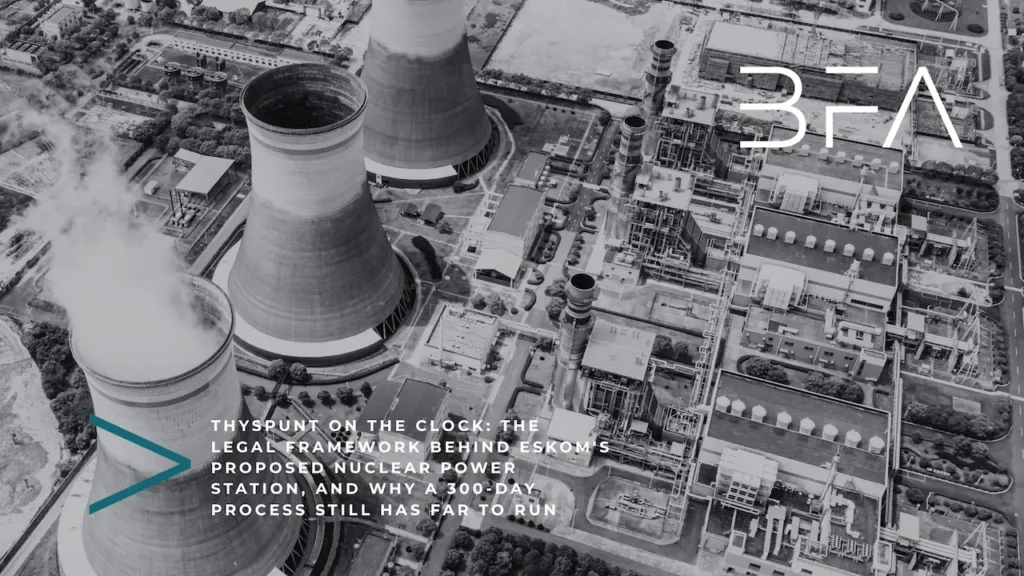
Eskom’s embattled proposal to build a nuclear power station at Thyspunt, near St Francis Bay in the Eastern Cape, remains, as at September 2026, considerably short of an approved project. Written parliamentary replies published by the Department of Forestry, Fisheries and the Environment (DFFE) on 11 September 2026 confirmed that the final scoping report for the project has been accepted, but that the detailed Environmental Impact Assessment (EIA) report, comprising the specialist studies on which the ultimate authorisation decision will turn, has not yet opened for public comment. Government could not say when that process will be completed.
The proposal itself is substantial. Local reporting puts the plant’s potential capacity at up to 5 200MW, occupying roughly 250 hectares, with an intended operating life of about 60 years, potentially extending to 80. Thyspunt was identified as the preferred site over the alternative Bantamsklip site in the Western Cape, partly because Eskom already owns the land and it lies closer to existing transmission infrastructure.
Background: A Process Still In Its Scoping And Specialist-Study Phase
The public participation process to date has not been small. Government has recorded 41 engagements during the pre-application and scoping stages, comprising two virtual information sessions, eight stakeholder meetings, twelve public meetings, eighteen focus groups and one meeting with the department, with 2 008 recorded attendances across the public and focus-group meetings alone. Those sessions stretched from St Francis Bay, Oyster Bay, Humansdorp and Jeffreys Bay to Gqeberha, with additional Western Cape sessions held because Bantamsklip remains under assessment as the alternative site.
Residents raised concerns spanning nuclear safety, marine ecology and fisheries, cultural heritage, construction impacts, the adequacy of public participation, and the broader social and economic effects of the project. Government has indicated that these issues have been placed within the scope of specialist work for the next phase, with approved studies covering marine ecology, freshwater supply, transport, tourism, health, climate change, radiological effects, waste transport, heritage, noise and economic impact, among other fields. Comprehensive findings on each of these are only due during the EIA stage itself, meaning the substantive environmental case for or against the project has not yet been placed before the public.
The Legal Framework Governing Nuclear New Build
A nuclear power station cannot lawfully be constructed or operated in South Africa on the strength of a single approval. It requires a chain of separate, sequential and independently enforceable authorisations, each governed by different legislation and, in most cases, a different regulator –
- Environmental authorisation under NEMA – the current Thyspunt process is being run under the EIA Regulations promulgated under NEMA, following the full scoping and environmental impact reporting procedure appropriate to a project of this scale and listed activity status. That process carries a prescribed overall statutory timeframe, ordinarily 300 days from acceptance of the application, which the competent authority may extend for specified periods where warranted. The Thyspunt application has already received two such extensions, placing it well beyond the ordinary statutory window with no confirmed completion date;
- A nuclear installation licence under the NNR Act – an environmental authorisation under NEMA, even once granted, does not itself authorise the construction or operation of a nuclear installation. A separate nuclear licence must be obtained from the National Nuclear Regulator, supported by its own independent safety case, and issued in stages corresponding to siting, construction, commissioning, operation and eventual decommissioning. Constructing or operating a nuclear installation without the requisite licence is a criminal offence under the NNR Act;
- A section 34 determination and NERSA licence under the ERA – before new generation capacity of this scale may be procured, the Minister responsible for energy must first determine, under section 34 of the ERA, that new capacity is needed and specify the technology and procuring entity, following which the generator must be licensed by the National Energy Regulator of South Africa (NERSA). This determination and procurement layer sits alongside, and is legally distinct from, the environmental and nuclear licensing tracks;
- Heritage authorisation under the National Heritage Resources Act 25 of 1999 – where a project of this scale affects sites or practices of cultural or heritage significance, as the engagement with Khoi-San Traditional Leaders described below illustrates, a further and separate statutory consultation process applies, running in parallel to, rather than as a substitute for, the NEMA public participation process; and
- Compliance with constitutional procurement and treaty requirements – given the scale and cost of a nuclear new-build programme, any associated intergovernmental cooperation agreements and procurement decisions must independently satisfy constitutional requirements, including section 231 of the Constitution governing the tabling of international agreements before Parliament, a requirement that proved decisive in the litigation discussed below.
Lessons From The Litigation That Halted The Last Nuclear Build Programme
Thyspunt is not new to this process. Together with Bantamsklip and Duynefontein near Cape Town, it was one of the candidate sites considered under South Africa’s earlier, considerably larger nuclear new-build programme, pursued between approximately 2010 and 2017, under which government sought to procure some 9 600MW of new nuclear capacity.
That programme was brought to a halt by the Western Cape High Court’s judgment in Earthlife Africa Johannesburg v Minister of Energy and Others 2017 (5) SA 227 (WCC), which reviewed and set aside the Minister’s section 34 determinations under the ERA authorising the nuclear build, together with the procurement process that had proceeded on the strength of intergovernmental agreements concluded with Russia, the United States and South Korea. The court found, among other things, that the Russian agreement in particular had not been properly tabled before Parliament as section 231 of the Constitution required, and that the process had proceeded without the transparency and public scrutiny its scale and cost implications demanded.
This history illustrates a theme that recurs throughout South African environmental and infrastructure law: government’s substantive commitment to a strategically important project, however pressing the underlying policy rationale of energy security may be, does not excuse it from full compliance with the applicable procedural, public participation and constitutional requirements at every stage. A project of Thyspunt’s scale that proceeds, at any point in its licensing chain, on the strength of an incomplete, rushed or procedurally deficient authorisation risks being set aside years into implementation, at a cost considerably greater than a properly sequenced process would have carried.
Unresolved Concerns: Infrastructure, Heritage And Local Opposition
The practical concerns raised during the public participation process to date go well beyond the reactor itself. The Kouga Municipality’s mayor, Hatting Bornman, has highlighted the strain an estimated 10 000-strong construction workforce would place on a small municipality’s water, sanitation, electricity and refuse removal infrastructure, noting that residents affected by any shortfall will be knocking on the municipality’s doors, not Eskom’s. Eskom’s response, through spokesperson Daphne Mokoena, has been that these socio-economic and infrastructure impacts are being evaluated alongside the environmental specialist studies, with mitigation measures to be developed in collaboration with the relevant authorities, municipalities and stakeholders should the project proceed.
Separately, the Sarah Baartman District Municipality has hosted stakeholder engagement between Eskom and Khoi-San Traditional Leaders on the proposed development, addressing biodiversity conservation, the protection of Khoi-San heritage, job creation, skills development and long-term environmental stewardship. This heritage-focused engagement track runs alongside, rather than in substitution for, the formal consultation obligations imposed by the National Heritage Resources Act, and its outcomes will need to feed into the heritage specialist study still to be released as part of the EIA report.
Organised local opposition, principally through the Thyspunt Alliance, together with environmental justice organisation Earthlife Africa and other environmental and heritage advocates, continues to raise concerns around nuclear safety, marine ecology and the cumulative burden the project would place on a coastal community. None of these concerns has yet been tested against the specialist findings that remain outstanding.
Where Things Stand, And What Comes Next
On the department’s own account, Thyspunt has advanced through paperwork, not to construction. The scoping phase has closed, but the detailed impact assessment, covering marine ecology, freshwater supply, radiological effects, heritage, health, noise and economic impact among other fields, has not yet been released for public comment, and no completion date has been given. Only once that report is published, scrutinised through a further round of public participation, and translated into a final decision by the competent authority, will the NEMA leg of the licensing chain be complete, and even then, the separate NNR Act nuclear licensing and ERA procurement processes described above would still need to run their own course before construction could lawfully begin.
How Bishop Fraser Attorneys Can Assist
The Thyspunt proposal is a useful illustration of just how layered the legal framework governing major energy infrastructure in South Africa has become, and of the risks that arise when any one link in that chain, environmental, nuclear, regulatory or constitutional, is treated as a formality rather than a substantive legal requirement.
Bishop Fraser Attorneys advises clients on NEMA environmental authorisation processes and appeals, engagement with the EIA public participation process, National Heritage Resources Act consultation obligations, and the regulatory and constitutional requirements applicable to major energy procurement decisions. We are well placed to assist stakeholders, whether project proponents, affected communities or organs of state, in navigating this framework and in anticipating the kind of procedural and constitutional risk that has, before now, proved decisive to the fate of a nuclear new-build programme in South Africa.