

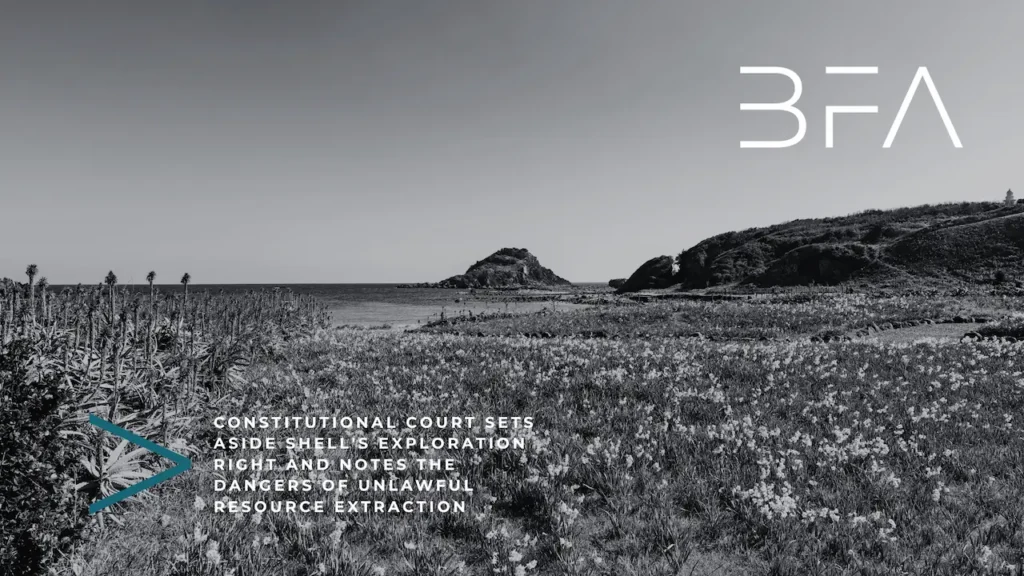
On 14 August 2026, the Constitutional Court handed down judgment in Sustaining the Wild Coast NPC and Others v Minister of Mineral Resources and Energy and Others; Natural Justice and Another v Minister of Mineral Resources and Energy and Others [2026] ZACC 33, setting aside the Supreme Court of Appeal’s (SCA) order that had kept alive an offshore exploration right held by Shell Exploration and Production South Africa B.V. and Impact Africa Limited off the Eastern Cape’s Wild Coast.
The judgment reinstates the effect of a 2022 High Court order that had already found the exploration right, and its subsequent renewals, to have been granted unlawfully. The Constitutional Court held that the defects in the original process, principally the failure to meaningfully consult affected coastal communities, could not be cured by a further renewal process more than a decade later.
Background To The Dispute
The exploration right at the centre of the dispute was originally granted to Impact Africa Limited in 2014 under the Mineral and Petroleum Resources Development Act 28 of 2002 (MPRDA), and was renewed in 2017 and 2021. Shell acquired a 50% participating interest in the right in 2021. The right covered a large area off the Wild Coast and would have permitted seismic surveying in the search for offshore oil and gas.
In 2022, the Eastern Cape Division of the High Court found that the grant of the exploration right, and both of its renewals, were unlawful and procedurally unfair. The Court found, among other defects, that Impact Africa had failed properly to identify the affected communities, that public notices were published only in English and Afrikaans in newspapers inaccessible to the predominantly isiXhosa-speaking communities concerned, and that Impact’s own consultants had been advised that broader community engagement was required but had failed to undertake it. The High Court also found that decision-makers had failed properly to consider climate change, the Integrated Coastal Management Act, and the precautionary principle.
The SCA agreed, in 2024, that the right had been granted unlawfully, but suspended the order setting it aside, allowing the right to remain in force pending a third renewal application under section 81 of the MPRDA, on condition that a further public participation process be conducted to correct the earlier consultation failures. It was this remedy that the affected communities and environmental organisations challenged before the Constitutional Court.
The Legal Framework Governing Lawful Exploration
The MPRDA sets out the exclusive route to lawful exploration and mining rights in South Africa. Sections 80 and 81 govern the grant and renewal of exploration rights respectively, and require, among other things, a properly constituted environmental management programme (EMPr) and compliance with public participation obligations under both the MPRDA and the National Environmental Management Act 107 of 1998 (NEMA). Coastal and marine activities additionally engage the Integrated Coastal Management Act 24 of 2008, and administrative decisions of this kind remain subject to the Promotion of Administrative Justice Act 3 of 2000 (PAJA), which requires that administrative action be lawful, reasonable and procedurally fair.
A central tension in the case was section 81(5) of the MPRDA, which provides that an exploration right remains in force pending the determination of a renewal application. The SCA reasoned that this provision allowed the right to be kept alive while a corrective public participation process was undertaken during the third renewal application. The Constitutional Court disagreed, holding that section 81 does not require the Minister to reconsider the underlying lawfulness of the original grant, and that the structure of a renewal application is simply not designed to cure a fundamentally defective consultation process that preceded the original decision by more than a decade.
Why A Defective Process Could Not Be Cured By Renewal
The Constitutional Court’s reasoning turned on several key findings that carry broader significance for the lawful conduct of exploration and mining activities –
- Consultation is a substantive right, not a formality – the Court held that meaningful consultation is tied to the dignity and agency of affected communities as participants in decisions affecting their land, culture and livelihoods. Requiring communities to be consulted more than a decade later does not vindicate the original violation of that right;
- Financial investment cannot outweigh grave unlawfulness – Shell and Impact Africa had invested approximately R1.1 billion in the project. The Court held that this expenditure, while relevant, had been given too much weight by the SCA, and that “financial interests should not be unduly elevated to overrule other factors in the enquiry into what is just and equitable”;
- Acquirers assume the legal risk of the underlying right – the Court rejected Shell’s argument that it should be treated as an innocent party because it had not itself conducted the defective consultation process. In acquiring its 50% interest, Shell also acquired the legal vulnerabilities attaching to Impact Africa’s original conduct; and
- A fresh application is required, not a repaired one – the Court held that a new application, including a new consultation process and a new EMPr, evaluated against current legal, scientific and factual circumstances, including the moratorium on new offshore applications, would be required for any future exploration in the area.
The Minority View
The judgment was not unanimous on remedy. Rogers J, with Savage J concurring, would have allowed the relevant decision-maker to determine whether Impact Africa and Shell should receive a final, limited period to explore, on the basis that a fresh consultation process, together with proper consideration of climate change and other relevant factors during the renewal, could adequately vindicate the affected communities’ rights. The majority rejected this approach, holding that it would allow a renewal process to sidestep the moratorium placed on new offshore exploration applications, a moratorium adopted in the public interest, and that it would treat the original violation of the right to be consulted as capable of being remedied after the fact. The disagreement on the bench itself underscores that the boundary between a curable procedural defect and an incurable substantive violation of constitutional rights is not always self-evident, and will continue to be tested in future resource-development litigation.
The Constitutional And Environmental Dimension
The judgment situates the dispute within South Africa’s constitutional framework governing natural resources as shared commons, engaging the rights to a healthy environment, just administrative action, culture, dignity and sustainable development. The Court emphasised the deep connection between Wild Coast communities and the ocean, extending beyond income and nutrition to ancestral practice, traditional healing and spiritual life, and situated the case within a longer history of resource-driven dispossession, referencing the Xolobeni mining dispute and the customary practices of the Dwesa-Cwebe communities.
The Court also rejected the framing of community rights and economic development as opposing interests to be weighed on a simple scale. While job creation was a legitimate consideration, it could not be assumed to be inherently beneficial without interrogating who would receive the jobs, how secure they would be, and what social, ecological and cultural costs the affected communities would bear in return.
Potential Impacts On The Energy, Mining And Exploration Sector
The judgment carries significant implications for companies holding, acquiring or seeking exploration and mining rights in South Africa –
- Consultation standards are substantially heightened – generic newspaper notices, particularly in languages inaccessible to affected communities, will not satisfy consultation obligations. Rights holders must properly identify affected parties and engage them directly, especially in multilingual and rural coastal or customary contexts;
- Transactional due diligence must extend to process, not only title – companies acquiring interests in exploration or mining rights, whether by farm-in, participation agreement or outright acquisition, inherit the full legal history of that right, including any pre-existing consultation or procedural defects. Title due diligence alone is insufficient; the lawfulness of the underlying grant must also be verified;
- Renewal and relicensing processes cannot cure a defective original grant – rights holders should not assume that a renewal, amendment or relicensing process can retrospectively repair an unlawful original consultation or environmental assessment. Courts are likely to require a genuinely fresh application, assessed against current legal and scientific circumstances;
- Sunk-cost arguments carry limited legal weight – substantial financial investment in a right, even at the scale of the R1.1 billion at issue here, will not be permitted to outweigh a finding of grave procedural unlawfulness, increasing the financial risk profile of large offshore and onshore exploration projects undertaken on an uncertain legal foundation; and
- The judgment reinforces a broader judicial trend – consistent with earlier decisions concerning customary and traditional communities, courts continue to insist on substantive, direct engagement with affected communities before extractive rights are granted, a principle equally applicable to mining, infrastructure and energy projects on communal or customary land.
The Road Ahead: The Moratorium And Future Applications
The Constitutional Court was careful to note that its judgment does not permanently bar Shell or Impact Africa from seeking an exploration right off the Wild Coast in future. Any future application, however, would have to be considered afresh, against the legal and factual circumstances applicable at that time, including the current moratorium on new offshore exploration applications, updated environmental and climate science, and a properly conducted consultation process from the outset. As the applicants’ representatives noted, the ruling closes off the existing route to the project rather than permanently prohibiting oil and gas exploration off the Wild Coast.
The case, argued by the Legal Resources Centre and Richard Spoor Inc Attorneys for the Wild Coast community applicants, and by Cullinan & Associates for Natural Justice and Greenpeace, has been described by practitioners as among the most closely watched environmental and administrative law disputes in South Africa’s constitutional era. Its emphasis on substantive consultation, and its rejection of financial sunk cost as a basis for legitimising an unlawful process, is likely to inform not only future offshore exploration applications but administrative law challenges to extractive rights more broadly.
How Bishop Fraser Attorneys Can Assist
The Wild Coast judgment is a significant precedent for the energy, mining and exploration sectors, with direct consequences for licensing compliance, community consultation and transactional risk.
Bishop Fraser Attorneys advises clients on MPRDA and NEMA licensing and consultation compliance, environmental management programme preparation, due diligence for resource-sector transactions, engagement with coastal and customary communities, and administrative law challenges and defences relating to mining and exploration rights. Early legal review of consultation processes and transactional risk may materially reduce exposure to the kind of invalidation seen in this judgment.