

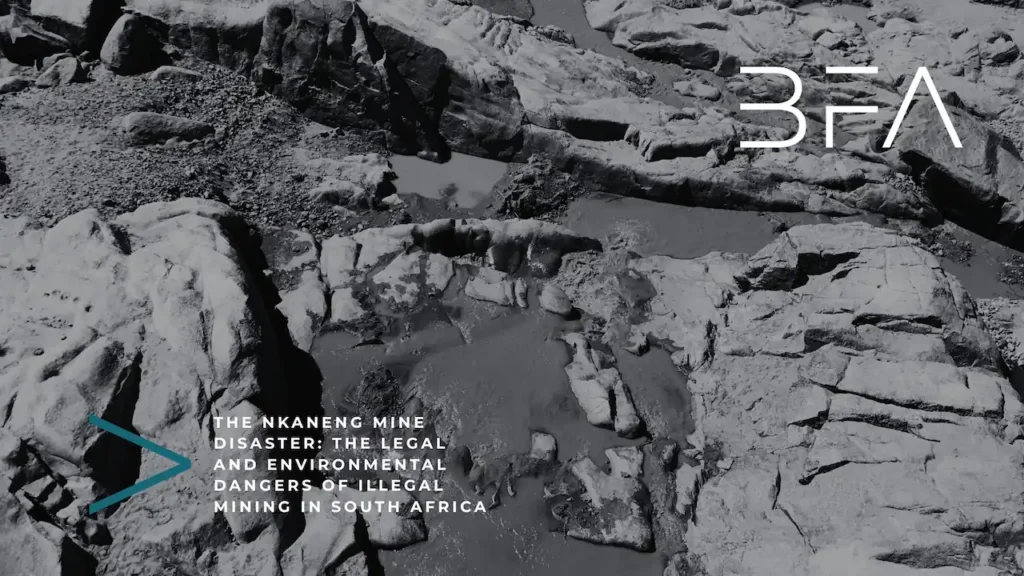
On the night of 10 to 11 August 2026, a rockfall and mudslide at a disused mine working in Nkaneng, near Rustenburg in the North West province, killed 14 unregistered miners, most of them Basotho nationals. Eight others were hospitalised, and police have warned that further miners may remain trapped underground.
The site fell within an area associated with Sibanye, a global mining and metals processing group, and had reportedly been the subject of a permit held by Sustenza Trading for the exploration of platinum group metals. Neither circumstance authorised the extraction activity that led to this tragedy.
This incident is the latest in a recurring pattern of fatal accidents involving unregulated mining, or so-called “zama zama” activity, at disused and derelict workings across South Africa, and follows the far larger Stilfontein disaster of August 2024, in which approximately 90 illegal miners died during a weeks-long police operation at a disused gold mine.
The Scale Of Illegal Mining
Thousands of unregistered miners operate in South Africa, scavenging abandoned and disused mine workings for gold, platinum group metals and other minerals, frequently in arduous and highly dangerous conditions. Many are undocumented foreign nationals, and the activity has been repeatedly linked to organised crime, extortion, violence and assassinations.
The South African Federation of Trade Unions has noted that the country has approximately 6,000 derelict, ownerless and inadequately secured mining sites, describing them as “death traps, environmental hazards and breeding grounds for organised criminal syndicates”. In response to the scale of the problem, President Cyril Ramaphosa announced in February 2026 the deployment of the South African National Defence Force to assist police in combating illegal mining. Police have continued enforcement operations in the interim, including the arrest of 24 undocumented foreign nationals near Stilfontein on 31 July 2026 in connection with suspected illegal gold mining.
What The Law Requires To Mine Lawfully
The Mineral and Petroleum Resources Development Act 28 of 2002 (MPRDA) establishes the exclusive legal route to lawful mining in South Africa. Depending on the scale and nature of the activity, a person or company must generally hold –
- Reconnaissance permission or a prospecting right – authorising the search for minerals, but not their extraction or removal for sale;
- A mining right or mining permit – authorising actual extraction of minerals, granted only once the applicant has demonstrated technical and financial capacity, and complied with environmental requirements;
- An environmental authorisation – required under the National Environmental Management Act 107 of 1998, integrated with the MPRDA through an approved environmental management programme, before any mining-related activity may lawfully commence;
- A water use licence – under section 21 of the National Water Act 36 of 1998, where mining activity involves the use, storage or discharge of water; and
- Compliance with the Mine Health and Safety Act 29 of 1996, the Explosives Act 15 of 2003, and, in respect of unwrought precious metals and diamonds, the Precious Metals Act 37 of 2005 and the Diamonds Act 56 of 1986.
Critically, a prospecting or exploration right does not authorise extraction. Mining without the correct right or permit is a criminal offence under section 98 of the MPRDA, and the possession or disposal of unwrought precious metals or rough diamonds without the requisite authority constitutes a separate offence under the Precious Metals Act and the Diamonds Act. On the facts reported, the presence of an exploration permit at Nkaneng did not, and could not, render the extraction activity at the site lawful.
Rights Holder Obligations And Liability For Disused Workings
Holders of mining and prospecting rights bear ongoing statutory duties in respect of disused and derelict workings on their land. Sections 41 to 43 of the MPRDA require rights holders to maintain financial provision for the rehabilitation and closure of mine workings, and closure may only be finalised once a closure certificate has been issued. Section 28 of NEMA imposes a general duty of care to prevent environmental harm, which extends to preventing unauthorised access to unsafe and unrehabilitated excavations.
Where illegal mining activity, and resulting deaths, occur on land subject to an existing right or permit, the rights holder may face regulatory scrutiny, and potentially civil or criminal exposure, where it can be shown that the site was inadequately secured or rehabilitated. For sites that are genuinely ownerless or predate the current regulatory regime, the primary obligation to remediate falls to the state under section 46 of the MPRDA, administered through the Department of Mineral Resources and Energy and the Council for Geoscience, a function widely regarded as significantly under-resourced relative to the scale of roughly 6,000 known derelict sites.
The Dangers Of Illegal Mining
Illegal mining operations, by definition, take place outside any regulated framework, and the dangers are correspondingly severe –
- Structural and physical safety – disused workings lack ventilation, structural support and any of the safety standards mandated under the Mine Health and Safety Act, making rockfalls, mudslides and collapses, as occurred at Nkaneng, a persistent and foreseeable risk;
- Environmental degradation – unregulated excavation and the absence of rehabilitation frequently result in acid mine drainage, contamination of groundwater and surface water resources, and land subsidence, undermining the principles of sustainable development embedded in NEMA; and
- Organised criminality – the sector has been consistently linked to extortion, trafficking, violence and, in some instances, direct threats to formal mining operations and surrounding communities.
Enforcement And Its Limits
Government’s response has increasingly relied on militarised and large-scale operations, including the deployment of the SANDF and the protracted 2024 Stilfontein siege, rather than on the systemic rehabilitation of derelict sites or the resourcing of MPRDA enforcement. Police have confirmed that the criminal investigation into the Nkaneng incident remains active, including efforts to determine whether further miners remain trapped, and the detention of survivors for further investigation. Absent a coordinated programme addressing the underlying stock of unsecured derelict mines, incidents of this nature are likely to recur.
Potential Impacts On Mining Right And Permit Holders
The Nkaneng incident carries the following implications for holders of mining, prospecting and exploration rights –
- Heightened security expectations – rights holders should expect increased regulatory and public scrutiny of the physical security of old and disused workings on land under their rights, regardless of whether the illegal activity is their own;
- Scrutiny of financial provision – the adequacy of financial provision for rehabilitation and closure under the MPRDA and NEMA financial provisioning regulations is likely to attract closer regulatory attention following high-profile incidents of this kind;
- Civil and reputational exposure – rights holders whose land hosts fatal illegal mining incidents may face reputational harm and civil claims, even absent direct involvement, where inadequate securing of the site can be demonstrated; and
- Potential regulatory reform – continued incidents of this nature increase the likelihood of legislative or regulatory reform strengthening derelict mine security and rehabilitation obligations under the MPRDA.
How Bishop Fraser Attorneys Can Assist
The Nkaneng disaster is a stark illustration of the human, environmental and legal consequences of illegal mining, and of the ongoing obligations that attach to rights holders in respect of disused and derelict workings.
Bishop Fraser Attorneys advises clients on MPRDA licensing and compliance, environmental authorisation and financial provisioning obligations, mine closure and rehabilitation certification, and liability risk assessments relating to derelict and disused workings. Proactive compliance review may materially reduce regulatory and civil exposure as enforcement attention on this sector continues to intensify.