

Introduction
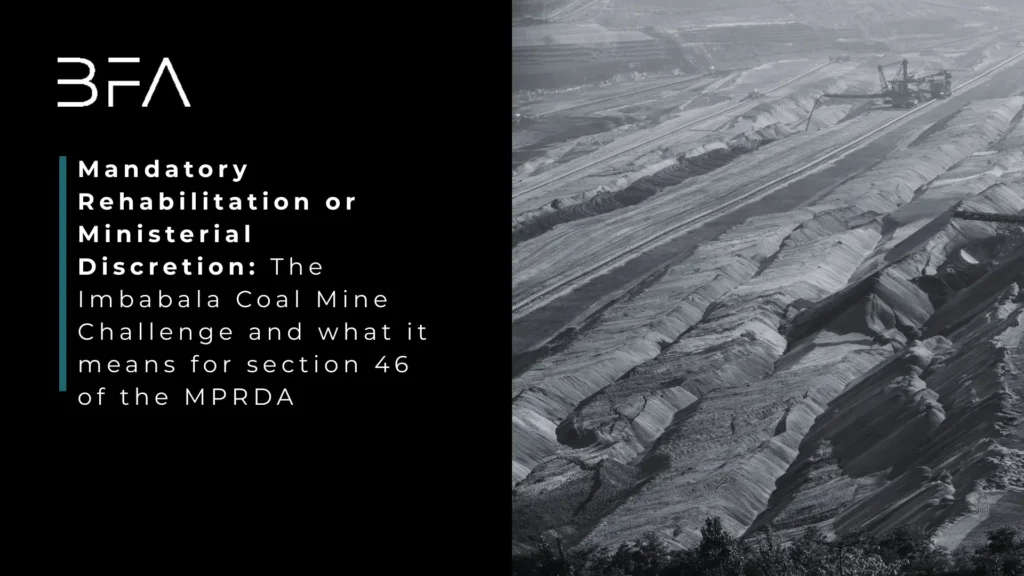
On 2 February 2026, the Mpumalanga Division of the High Court received an application in Khuthala Environmental Care Group and Others v Minister of Mineral and Petroleum Resources and Others (Case No. 2026-019719) that goes to the heart of South Africa’s abandoned-mine crisis. The applicants, a community-based environmental organisation and the concerned residents of three settlements adjoining the abandoned Imbabala Coal Mine outside Ermelo, Mpumalanga, have asked the Court to do two things.
First, they seek an order compelling the Department of Mineral and Petroleum Resources (DMPR), the Minister of Mineral and Petroleum Resources, the Minister of Public Works and Infrastructure and the Msukaligwa Local Municipality to rehabilitate the abandoned Imbabala Mine and to take immediate interim safety measures on the site.
Second, they seek a declaration that section 46(1) of the Mineral and Petroleum Resources Development Act 28 of 2002 (MPRDA) is inconsistent with section 24(b)(i) of the Constitution and invalid, on the basis that it clothes the Minister with a discretion to act in respect of abandoned and ownerless mines rather than imposing a peremptory duty.
The application, brought with the assistance of the Centre for Environmental Rights (CER), is significant for mining law practice. It squarely raises the question of whether section 46 of the MPRDA is constitutionally adequate as the legislative mechanism through which the State is expected to address an estimated 6,100 derelict and ownerless mines across South Africa, including at least 400 abandoned coal mines in Mpumalanga alone.
Background
The Imbabala Mine and its abandonment
In May 2005, the then Department of Minerals and Energy granted Imbabala Coal (Pty) Ltd (Imbabala Coal) a five-year mining right to conduct open-cast coal mining on Portion 112 and the remaining extent of the farm Nooitgedacht near Ermelo, Mpumalanga. The farm is surrounded by several communities, both formal and informal, including the Wesselton township within the Msukaligwa Local Municipality.
In 2011, Imbabala Coal was ordered to cease operations at the mine after the departments of Minerals and Energy and Water and Sanitation found it to be operating without a water-use licence. Imbabala Coal then abandoned the site entirely, leaving open pits, contaminated land and no rehabilitation in place. The company was deregistered on 3 February 2018. Its former owners and directors cannot be traced.
The DMPR holds a financial provision guarantee (Guarantee No. 36280507319) in the amount of R600,000 in respect of the mine. The same department has itself estimated the actual cost of full rehabilitation at approximately R450 million.
The impact on surrounding communities
At minimum two people have drowned in the open pit since the mine’s closure, including two teenage boys on 24 September 2016. Adults too have fallen into the pit, with injuries that have left community members permanently disabled, and livestock has been lost to the same pit.
The open pit has become a crime hotspot, with reports of robbery and sexual assault on the unguarded site. In June 2024, a resident of Nomzamo Agri-Village, Nthabiseng Jele, fell into a collapsing section of the mine site while collecting coal for cooking (the community in that area has no access to electricity) and sustained injuries that left her reliant on crutches.
Independent water quality testing conducted in May 2022 by GCS Water and Environmental Consultants, commissioned by the CER and Khuthala, confirmed contamination consistent with an impact from the abandoned mine. Community members use this water to irrigate crops and water livestock. The land around the mine, previously used for food gardens and grazing, has been rendered non-viable by the mine’s environmental legacy. Houses in Thusi Ville, a township that predates the mine, were cracked by Imbabala’s blasting activities and were never repaired.
Engagement with the DMPR and DPWI
Since 2019, Khuthala and the CER have engaged repeatedly with the DMPR and the Department of Public Works and Infrastructure (DPWI) on the rehabilitation of the Imbabala Mine. A site inspection in August 2019 led the DMPR to issue a directive to the directors of Imbabala Coal in September 2019, acknowledging both non-compliance with the National Environmental Management Act 107 of 1998 (NEMA) and the severity of the environmental degradation at the site. The directive was returned unserved: the company had by then been deregistered and the directors could not be located.
Subsequent correspondence between the CER, the DMPR and the DPWI produced no meaningful action. A formal demand by the CER in July 2025 for production of Imbabala’s environmental management programme went unanswered. The applicants accordingly approached the Court.
The Application
Part A: Compelled rehabilitation and interim relief
Part A of the application is a mandatory interdict proceeding. It seeks the following substantive orders:
- Declaration of category: A direction that the Minister acknowledge Imbabala Mine as falling within the category of mines described in section 46(1) of the MPRDA, that is, a mine whose holder has ceased to exist or cannot be traced;
- Call-up of financial provision: A direction that the DMPR call up the financial provision guarantee held for Imbabala Mine under section 46(2) of the MPRDA;
- Interim safety measures: A direction that the Minister, the Public Works Minister and the Municipality erect fencing and warning signs and drain water from the mine pits within three months;
- Rehabilitation plan: A direction that the DMPR commission a rehabilitation plan incorporating an economic diversification component under section 2(d) of the MPRDA, developed in consultation with the applicants, within six months;
- Full rehabilitation: A direction that the DMPR conduct the rehabilitation of Imbabala Mine within eighteen months;
- Parliamentary funding where insufficient: A direction that, to the extent the financial provision is inadequate, the Minister make available funds appropriated by Parliament for this purpose under section 46(2) of the MPRDA; and
- Potable water: A direction that the Municipality provide potable water to affected communities via water tankers within 30 days, pending full rehabilitation.
The applicants have reserved their right to approach the Court on the same papers should the respondents fail to comply.
Part B: Constitutional invalidity of section 46(1)
Part B is a constitutional challenge. The applicants seek a declaration that section 46 of the MPRDA is inconsistent with section 24(b)(i) of the Constitution and invalid, on the basis that it fails to provide mechanisms — whether in the form of policy or regulations — for the determination, classification and implementation of rehabilitation for mines categorised as abandoned, derelict and/or ownerless under section 46 of the MPRDA.
The applicants also seek a suspension of the order of invalidity for 24 months to allow Parliament to remedy the inconsistency. During the suspension period, they seek a reading-in: that the word “must” replace “may” in section 46(1), so that the provision would read in relevant part: “the Minister must instruct the Regional Manager concerned to take the necessary measures to prevent pollution or ecological degradation of the environment or to rehabilitate dangerous health and social occurrences or to make an area safe.”
The Legal Architecture — Section 46 And Its Shortcomings
The constitutional architecture governing mine rehabilitation has three relevant layers.
- Section 24(a) of the Constitution guarantees everyone the right to an environment not harmful to their health or well-being. Section 24(b) imposes a positive obligation on the state to protect the environment through reasonable legislative and other measures that prevent pollution and ecological degradation. Section 237 requires all constitutional obligations to be performed diligently and without delay.
- The MPRDA, which came into operation in 2004, is the principal statutory instrument giving effect to section 24 in the mining context. Its primary mechanism for post-closure environmental accountability is the obligation on a mining right holder to make financial provision for rehabilitation as a condition of holding the right. Under section 43, environmental liability persists beyond the cessation of operations. Under section 45, the Minister may issue directives to holders (or former holders) who cause environmental damage. Under section 46, where the holder “cannot be traced” or has “ceased to exist”, the Minister may instruct the relevant Regional Manager to take the necessary measures.
- The applicants’ case in Part B is that the word “may” is the problem. Section 46(1), as currently worded, confers a discretion on the Minister rather than a duty. On the applicants’ analysis, this discretion, reinforced by the DMPR’s historically poor rehabilitation record and the absence of any gazetted policy framework for classifying and prioritising abandoned-mine rehabilitation, renders the provision constitutionally inadequate under section 24 of the Constitution.
Practical Significance
Active right holders, the DMPR, financiers and investors in the South African mining sector should take note of the following.
- The section 46 framework is under active constitutional scrutiny. Until the application is resolved, it is prudent to treat the existing legislative framework as contested. The prospect of a 24-month reading-in, making ministerial intervention mandatory, creates regulatory uncertainty for transactions and operations that may rely on the DMPR’s discretion not to intervene in adjacent or related sites.
- Financial provision levels remain a significant exposure. The R600,000 vs R450 million funding gap at Imbabala is illustrative of a systemic problem. Right holders should ensure that their financial provision levels are maintained at amounts that genuinely reflect rehabilitation costs, as inadequate provision is likely to attract increasing regulatory and litigation scrutiny.
- The ‘ownerless and derelict’ vs ‘abandoned’ classification gap has transactional consequences. Where a mine is acquired in distress, emerges from a liquidation, or is restructured, the classification of the site under the MPRDA will determine whether the acquiring entity inherits legacy environmental obligations. Transactional due diligence should include a careful analysis of the site’s rehabilitation status and the adequacy of any financial provision held by the DMPR.
- Community consultation obligations may extend beyond current practice. The relief sought in Part A would, if granted, impose a specific obligation to consult with affected communities at the pre-feasibility stage of a rehabilitation plan, and throughout the rehabilitation process. Proactive community engagement in planning for mine closure is increasingly a legal (not merely reputational) imperative.
- The Parliamentary appropriation backstop is not hypothetical. The applicants are seeking to activate section 46(2) directly through litigation. The outcome has implications for national budget planning, for the DMPR’s rehabilitation prioritisation, and for the liability profile of the state as ultimate backstop for the estimated R14 billion in derelict-mine rehabilitation obligations that Mpumalanga alone represents.
How Bishop Fraser Attorneys Can Assist
Mine closure, rehabilitation and the environmental obligations of current and former right holders are core components of Bishop Fraser Attorneys’ mining law practice. We advise mining companies, acquirers, financiers and communities on:
- the interpretation and application of section 43, 45 and 46 of the MPRDA, including the scope of the environmental liability that persists beyond the cessation of operations;
- the structuring of transactions to allocate mine rehabilitation liability, including the adequacy of financial provision and the risk of Parliamentary backstop exposure;
- regulatory engagement with the DMPR on the classification, prioritisation and funding of rehabilitation at abandoned, derelict and ownerless mine sites;
- the development of rehabilitation plans and the management of community consultation processes under sections 2(d) and 46 of the MPRDA;
- constitutional review of administrative failures and legislative deficiencies in the mine closure context, including PAJA review of the DMPR’s failure to act on environmental obligations;
- advising on the legal consequences of the classification gap between ‘abandoned’ and ‘derelict and ownerless’ mines, particularly in the context of distressed transactions, liquidations and restructurings.
The Imbabala application represents one of the most direct challenges to the constitutional adequacy of South Africa’s mine closure regulatory framework to date. Whether or not the Part B declaration of invalidity succeeds, the application is likely to accelerate both regulatory reform and increased judicial scrutiny of the DMPR’s discharge of its obligations under section 46. Mining companies, transactions advisers and financiers who treat rehabilitation as a tail-end compliance matter rather than a core regulatory risk do so at increasing peril.