

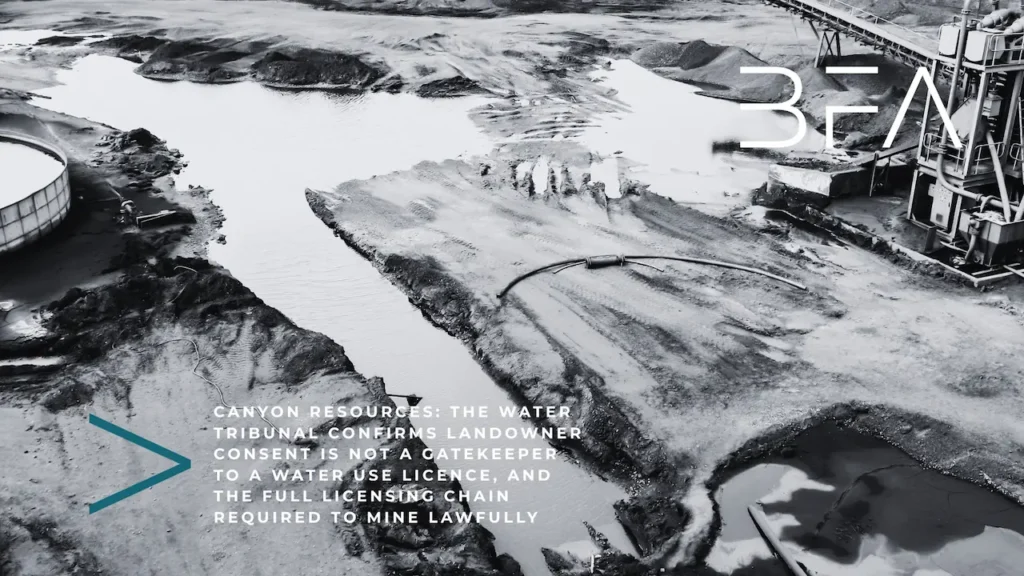
On 27 July 2026, the Water Tribunal handed down judgment in Canyon Resources (Pty) Ltd v Chief Director: Water Use Licensing Management, Department of Water and Sanitation and Others (WT02/25/MP), upholding an appeal against the Department of Water and Sanitation’s (DWS) refusal of an integrated water use licence (IWUL) for the proposed Driefontein coal mine near Middelburg, Mpumalanga. The refusal turned on a single issue: the private landowner had not signed the prescribed consent form.
The Tribunal held that a landowner’s refusal, or inability, to sign a consent form is not, on its own, a lawful basis to refuse an IWUL where the substantive statutory requirements have otherwise been met, and that outstanding land access disputes may be resolved after the licence is granted, through the National Water Act’s own servitude and compensation mechanisms, rather than being treated as a precondition to licensing.
Background To The Dispute
Canyon Resources Proprietary Limited, a coal exploration, mining and processing company established in 2006, applied to the Department of Mineral Resources and Energy for a mining right under the Mineral and Petroleum Resources Development Act 28 of 2002 (MPRDA) for the Driefontein Mine, and separately applied for an environmental authorisation and a waste licence under the National Environmental Management Act 107 of 1998 (NEMA) and the National Environmental Management: Waste Act 59 of 2008 (NEMWA). The proposed mine also required an IWUL under section 40 of the National Water Act 36 of 1998 (NWA) for several listed water uses under section 21.
Following a pre-application process, site inspection and public participation conducted jointly under the MPRDA and NEMA, DWS accepted Canyon’s IWUL application for processing in September 2023. In February 2025, DWS refused the application, stating that Canyon had failed to obtain a signed landowner consent form (Form DW902), despite the landowner having actively participated in the public participation process without raising any objection.
The Full Licensing Chain Required To Mine Lawfully
The Driefontein Mine dispute is a useful illustration of just how many separate authorisations must be in place before mining may lawfully commence in South Africa. Depending on the nature of the operation, a lawful coal, or other, mining project generally requires –
- A mining right under sections 22 and 23 of the MPRDA, authorising the extraction of the mineral in question;
- An environmental authorisation under NEMA, triggered where the project involves listed activities under Listing Notices 1 and 2, and integrated with the mining right application through the “one environmental system“;
- A waste management licence under NEMWA, where the project triggers listed waste activities;
- An integrated water use licence under sections 40 and 41 of the NWA, where the project involves any of the listed water uses under section 21, such as impeding flow, altering a watercourse, or storing or discharging water; and
- Resolved land access arrangements, whether by the landowner’s agreement, a registered servitude under sections 126 to 131 of the NWA, or compensation under section 54 of the MPRDA, before physical operations commence on land the rights holder does not own.
Each of these authorisations is separately enforceable. Mining without a valid mining right is an offence under the MPRDA; commencing a listed activity without an environmental authorisation is an offence under NEMA; operating without a required waste licence is an offence under NEMWA; and using water without the required authorisation is an offence under section 151 of the NWA, carrying fines and potential imprisonment. A rights holder that proceeds with any listed activity before every relevant authorisation is in place, not only a criminal syndicate operating entirely outside the law, exposes itself to the same category of unlawful conduct that underlies the dangers of illegal mining more broadly: operations conducted without the requisite legal authority, regardless of scale or intent, fall outside the protection of the law and expose those responsible to criminal prosecution, licence revocation and civil liability.
The Dispute: Was Landowner Consent A Precondition
Canyon Resources argued that DWS had exceeded its powers under the NWA by treating landowner consent as a precondition for an IWUL. It argued that the consent form is included in Annexure C to the Water Use Licence Application and Appeals Regulations, 2017 as part of an administrative checklist, rather than as a substantive requirement under the Act itself, and that DWS’s own Record of Recommendation, prepared by its technical sub-directorates, supported the granting of the licence. Canyon further argued that, where consent genuinely cannot be obtained, the appropriate remedy lies in the statutory servitude provisions in sections 126 to 131 of the NWA, or the compensation mechanism in section 54 of the MPRDA, invoked after the licence has been granted, not before.
DWS argued that section 41(1)(a) of the NWA, read with section 24, which deals with the use of water found underground on land the applicant does not own, made landowner consent a peremptory requirement, and that granting a licence without it risked an arbitrary deprivation of the landowner’s property rights under section 25 of the Constitution. DWS relied heavily on the Tribunal’s earlier decision in Labonte 5 (Pty) Ltd v Minister of Water and Sanitation, in which a failure to satisfy consent requirements had proved fatal to the application.
The Tribunal’s Findings
The Tribunal, exercising its wide appeal jurisdiction, which permits a full rehearing and redetermination on the merits rather than a narrow review of the record, sided with Canyon Resources. It found that the substantive administrative and technical information required for the application had been provided, and that the landowners had participated in the public participation process without objecting to the proposed water use.
Critically, the Tribunal distinguished Labonte 5 on the basis that it concerned an ordinary water use licence, not an IWUL linked to an existing mining right. Where an applicant already holds a mining right, it may invoke the servitude mechanism under sections 126 to 131 of the NWA, or the compensation regime under section 54 of the MPRDA, once the IWUL has been granted, rather than being permanently blocked at the licensing stage by an unresolved private land dispute. The Tribunal accordingly set aside DWS’s refusal and granted the IWUL, subject to the condition that outstanding land access issues be resolved either by agreement between the parties or by registration of a servitude.
Legal And Environmental Implications
The judgment confirms an important sequencing principle: the environmental and technical merits of a water use application, including resource availability and impact on water quality, are properly assessed separately from private law disputes over land access. A landowner’s unilateral refusal, or simple unavailability, to sign a consent form cannot function as an unlegislated veto over an otherwise compliant and environmentally sound application, particularly where the legislature has already created specific servitude and compensation mechanisms to resolve exactly this kind of access dispute without indefinitely freezing lawful resource development.
The ruling is not, however, a green light to commence mining operations. The IWUL was granted subject to land access issues still being resolved, meaning that Canyon Resources cannot lawfully commence water use activities, or associated mining operations, on the affected portions of land until access has been secured by agreement, servitude or compensation order. A rights holder that begins physical operations without having done so remains exposed to civil remedies, including interdicts for trespass, notwithstanding that its IWUL has been granted. The gap between holding a licence on paper and having lawful physical access on the ground is a recurring and underappreciated risk in South African mining and water law.
It should also be noted that, under section 149 of the NWA, a party may appeal a Water Tribunal decision to the High Court on a question of law within 21 days. At the time of writing, DWS had not indicated whether it intends to do so, meaning the judgment may not represent the final word on this issue.
Potential Impacts On The Mining Sector
The judgment carries the following implications for mining right holders and their advisers –
- Unblocking stalled projects: mining right holders whose IWUL applications have stalled solely because of landowner consent disputes may now rely on this precedent to press regulators to determine applications on their substantive merits;
- Sequencing risk remains: a granted IWUL does not, by itself, authorise physical operations where land access has not been resolved. Rights holders must still secure agreement, a registered servitude, or a compensation order before commencing activities on affected land, or risk civil liability and, in substance, unlawful conduct;
- Ordinary water use licences remain more exposed: Labonte 5 continues to apply to standalone water use licence applications that are not linked to an existing mining right, meaning applicants without an integrated application may still face a stricter, and potentially fatal, consent requirement;
- Appeal risk creates continuing uncertainty: given DWS’s option to appeal to the High Court under section 149 of the NWA, mining right holders should treat this precedent with appropriate caution pending clarity on whether an appeal is lodged; and
- The case reinforces the integrated licensing risk generally: lawful mining requires an unbroken chain of authorisations, comprising the mining right, environmental authorisation, waste licence and IWUL, together with resolved land access. A gap anywhere in that chain, whether regulatory or in respect of physical access, carries the risk of delay, dispute, or genuinely unlawful operation.
How Bishop Fraser Attorneys Can Assist
The Canyon Resources judgment is a significant and practical precedent for mining right holders navigating integrated water use licensing, and a reminder of the full regulatory chain required to mine lawfully in South Africa.
Bishop Fraser Attorneys advises clients on MPRDA, NEMA, NEMWA and NWA licensing applications, integrated water use licence appeals before the Water Tribunal, land access negotiations and servitude registration, and compliance strategies designed to avoid the legal and operational dangers of commencing activities ahead of a complete and lawful licensing chain.