

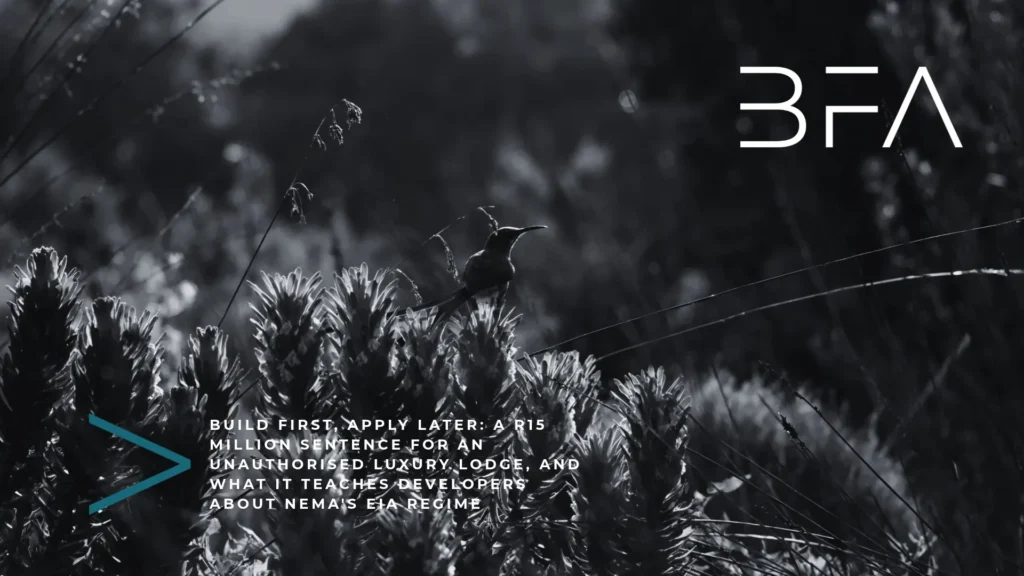
On 16 October 2026, VEA Group Holdings Proprietary Limited, the developer of the Goats Window luxury safari lodge near Bonnievale in the Western Cape, pleaded guilty in the Bonnievale Regional Court to two environmental offences and was sentenced in terms of a plea and sentence agreement concluded with the National Prosecuting Authority (NPA). The total penalty is R15 million, of which R10 million is suspended for five years and R5 million is payable in five instalments of R1 million to the conservation organisation Stop Rhino Poaching. The developer separately paid an administrative fine of R1.75 million to the Department of Forestry, Fisheries and the Environment (DFFE) to initiate an application for retrospective approval of the unlawful development.
The charges arose from the construction of 23 tourism units, together with access roads, parking and associated infrastructure, without the environmental authorisation required under the National Environmental Management Act 107 of 1998 (NEMA), and from the clearing of more than 4 000 mu00b2 of endangered renosterveld. The case is a stark illustration of the consequences of treating environmental authorisation as something to be regularised after the fact, and it is reported to be the first matter in which DFFE has been involved where a NEMA sentence included a court-ordered payment to Stop Rhino Poaching.
Background: The Development And The Offences
The lodge was built on a goat stud farm about 11 km south of Bonnievale, in the foothills of the Riviersonderend mountains. The completed complex comprises three directors’ units, two lodge units, ten glamping pods, four lapa units, access roads, parking and associated infrastructure. According to the plea documentation, construction began on 06 June 2024 and was completed on 03 April 2025.
Two listed activities formed the basis of the charges. First, the lodge lies within the Riviersonderend Mountain Catchment Area, a declared protected area under the National Environmental Management: Protected Areas Act 57 of 2003, in which any tourism or hospitality facility sleeping 15 people or more requires environmental authorisation in the Western Cape. Second, some 4 181 mu00b2 of endangered Breede Shale renosterveld was cleared, where the clearing of more than 300 mu00b2 of natural vegetation in an endangered ecosystem requires prior authorisation. The works also triggered activities under the National Heritage Resources Act 25 of 1999.
The developer pleaded guilty to two counts, which were taken together for purposes of sentence. The investigation and prosecution are reported to have been under way since January 2025.
The Statutory Framework
The case engages the core architecture of NEMA’s environmental impact assessment regime u2013
- The authorisation requirement u2013 section 24F of NEMA prohibits the commencement of a listed activity without a prior environmental authorisation. The listed activities are identified in the Listing Notices published under the Environmental Impact Assessment Regulations, 2014, as amended, which prescribe the thresholds, such as the 15-person facility and 300 mu00b2 vegetation clearance thresholds engaged here, above which an assessment must be undertaken before work begins;
- The offence and penalty provisions u2013 commencing a listed activity without authorisation is an offence under section 49A of NEMA, and section 49B provides for fines of up to R10 million, imprisonment of up to ten years, or both. The penalty must be considered together with the court’s wider powers on conviction, including orders for remedial measures and compensation;
- Protected area and biodiversity protection u2013 the Protected Areas Act and the National Environmental Management: Biodiversity Act 10 of 2004 impose additional controls where development takes place in a protected area or affects threatened ecosystems, which is why both the location and the vegetation type featured in the charges;
- Rectification under section 24G u2013 NEMA allows a person who has commenced a listed activity unlawfully to apply for rectification, which requires the payment of an administrative fine before the application is considered. Payment of that fine does not, however, absolve the applicant from prosecution, and the R1.75 million reported here should be understood in that light; and
- Enforcement tools u2013 DFFE had served notice under NEMA on the developer, and the Langeberg Local Municipality had issued a cease-work order. Both were reportedly ignored, which became a central aggravating factor.
The Plea And Sentence Agreement
The matter was resolved by way of a plea and sentence agreement under the Criminal Procedure Act 51 of 1977, which allows the prosecution and an accused to agree on a plea and an appropriate sentence, subject to the court’s satisfaction that the sentence is just. The accused was represented by one of its directors. The sentence was structured as follows u2013
- R10 million suspended for five years u2013 the suspended portion operates as a deterrent against reoffending and, in effect, makes the developer’s future conduct a condition of avoiding payment;
- R5 million payable to Stop Rhino Poaching u2013 the court-ordered payment to a conservation non-profit, in five R1 million instalments, directs part of the penalty to conservation work instead of the fiscus. DFFE has noted that similar payments have been ordered in matters involving biodiversity legislation, but that this is the first it is aware of involving contraventions of the EIA Regulations; and
- R1.75 million administrative fine u2013 paid separately to initiate the retrospective application. It is distinct from the criminal penalty and does not form part of the R15 million.
The developer reportedly stated that the expected capital value of the lodge on completion would be R50 million, with expected annual income or economic contribution of R12 million. Against that backdrop, the portion of the penalty that is payable rather than suspended is a relatively modest proportion of the project’s value, a point that objectors raised.
Aggravating And Mitigating Factors
The plea documentation sets out the factors considered in determining the quantum. The aggravating factors reported include that the offences were not isolated or momentary but occurred over an extended period, during which the developer persisted with a listed activity without authorisation; that the catchment area is of recognised environmental sensitivity and strategic importance for water security, so that the unauthorised development posed a real risk of irreversible harm; that the clearing of indigenous vegetation was not minor and caused permanent disturbance of natural habitat; that the conduct was undertaken for commercial gain; and that the developer did not immediately stop work, or cease operating the tourist facilities, upon receiving a NEMA notice and the municipal cease-work order.
The documentation records that the developer was fully aware the development was unlawful by 02 December 2024, when a specialist declaration for a retrospective application was signed, and that an independent environmental assessment practitioner was appointed. Public participation material issued in January 2025 described the application as one for the regularisation of illegal activity already undertaken. Work nonetheless continued until April 2025.
The mitigating factors were the absence of previous convictions, the plea of guilty and remorse, the avoidance of a protracted trial, cooperation with investigators, the fact that no irreversible environmental degradation had yet been identified in the available specialist reports, the job creation and skills development associated with the lodge, and the developer’s reported annual tax contribution. The developer also stated that it is making every effort to bring the development into compliance.
Objections And The Position Of DFFE
Four appellants, being two local landowners, an independent environmental consultant acting for an anonymous objector, and the Langeberg Local Municipality, appealed the amount of the administrative fine, among other things on the basis that it was too lenient. DFFE dismissed the appeals. The department welcomed the conviction and sentence, stating that the outcome reinforces the obligation on developers to obtain the necessary environmental authorisation before commencing any development requiring it, and underscores the consequences of failing to do so.
The website of the developer has been reported to carry a notice that the lodge is temporarily closed until further notice. The retrospective application remains pending, and nothing in the sentence determines whether authorisation will ultimately be granted, or on what conditions.
Lessons For Developers And Operators
The case carries the following practical lessons u2013
- Authorisation must precede construction u2013 there is no lawful route to start a listed activity first and regularise it later. Rectification under section 24G is an exception for a contravention that has already occurred, not a planning tool, and it carries both an administrative fine and ongoing criminal exposure;
- Directives and cease-work orders must be obeyed immediately u2013 the most damaging feature of the matter was continued construction after notice from both DFFE and the municipality. Obeying a notice while contesting it is almost always the safer course;
- Awareness converts negligence into wilfulness u2013 once a developer or its advisers have recognised the unlawfulness, as the appointment of an environmental practitioner for a retrospective application indicates, continuing work will be treated as a deliberate and sustained contravention;
- Location and vegetation thresholds are easily triggered u2013 protected area status and endangered ecosystem designations lower the thresholds at which authorisation is required. Early screening of a site against the Listing Notices, protected area registers and biodiversity plans is essential, particularly for tourism and agricultural developments in the Cape Winelands and similar sensitive regions;
- Sentences are increasingly creative u2013 suspended penalties, payments to conservation organisations and parallel administrative fines mean that the total consequence of a breach may be both larger and more varied than the headline fine suggests; and
- Directors and shareholders should take note u2013 this matter was resolved at the level of the company, but section 34(7) of NEMA allows directors to be held personally liable for certain offences where they failed to take all reasonable steps to prevent them, and boards of development companies should treat environmental authorisation as a governance issue.
How Bishop Fraser Attorneys Can Assist
The Goats Window sentence is a clear reminder that environmental authorisation is a precondition to development, not a formality to be completed alongside or after it.
Bishop Fraser Attorneys advises developers, landowners and operators on screening projects against listed activities, environmental authorisation and section 24G rectification applications, responding to compliance notices, directives and cease-work orders, plea and sentence negotiations in environmental prosecutions, and the personal liability of directors under NEMA. Early legal involvement, before ground is broken, is almost always the most cost-effective protection against enforcement of this kind.