

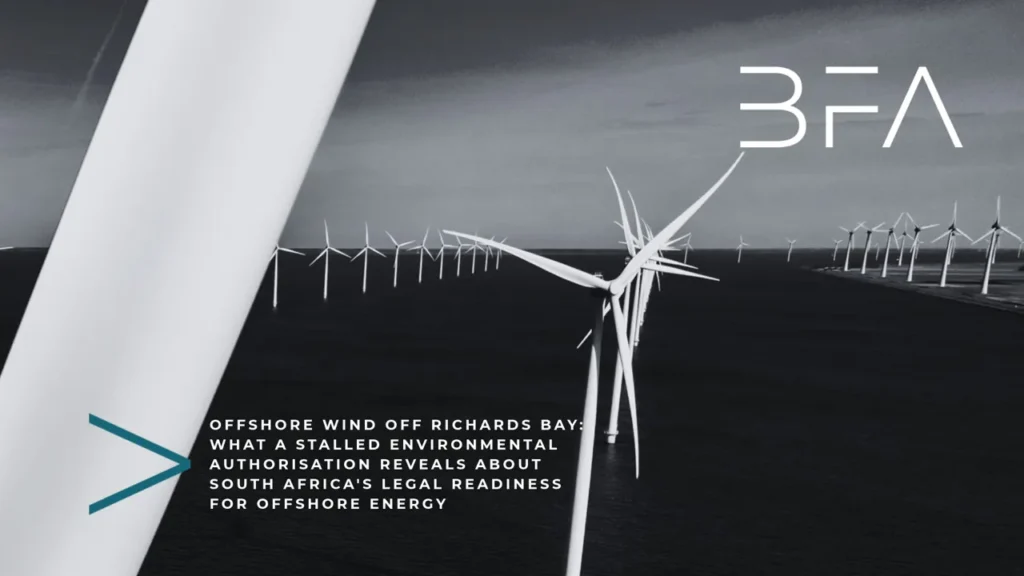
South Africa’s first proposed offshore wind farm, the Gagasi project off Richards Bay on the KwaZulu-Natal coast, has stalled. Reports on 17 September 2026 indicate that the environmental impact study for the project is on hold pending new technical information from the developers, GenesisHexicon, a joint venture between Sweden’s Hexicon and South Africa’s Genesis Eco-Energy Developments. The consultancy appointed to run the assessment, Acer (Africa) Environmental Consultants, confirmed that the environmental authorisation application was withdrawn last year, and said it was unsure of the project’s current status.
The delay coincides with the World Bank’s release of its South African offshore wind development framework study, which estimates that the country has potential for approximately 95 GW across selected coastal areas, mainly for floating technologies. The Bank estimates that large-scale development could contribute $6.7 billion in employment wages to the domestic economy by 2050 and reduce electricity generation emissions by 530 million tons of CO2 over 25 years.
Background: The Gagasi Project
The Gagasi project was launched in 2022. According to the background information document published for the compulsory environmental impact assessment in October 2024, it was proposed as a floating wind farm of up to 54 turbines, covering about 140 kmu00b2 in deep water off northern KwaZulu-Natal, between roughly 5 km and 17 km from the coastline. The assessment was to consider the worst-case scenario in terms of the maximum turbine size expected to be available at the time of construction, and construction was expected to be phased over some ten years.
The preliminary list of impacts for assessment included effects on the seabed, the laying of cables and anchoring of floating platforms in sensitive marine environments, and potential disruption to seabirds, marine mammals, turtles and commercial and recreational fisheries during installation and operation. Grid connection was to require a new substation at Richards Bay together with offshore substations.
According to Acer, the application was withdrawn so that the project could be redesigned from floating to anchored (bottom-fixed) turbines..
The Legal Framework Governing Offshore Wind
South Africa has no dedicated offshore wind statute. In reply to a parliamentary question in May 2025, the Department of Forestry, Fisheries and the Environment (DFFE) confirmed that marine renewable energy is in the early phases of development, that offshore wind is being explored under the Offshore Wind Roadmap for South Africa, and that, while a policy framework supporting wind energy exists, specific regulations for offshore wind projects would still need to be developed. In practice, a project of this kind must therefore be assembled from several regimes u2013
- Environmental authorisation under NEMA u2013 the National Environmental Management Act 107 of 1998 (NEMA) and the Environmental Impact Assessment Regulations, 2014, as amended, require an environmental authorisation before a listed activity may commence. DFFE has indicated that offshore wind projects require extensive assessments, particularly for floating platforms in deep water, and that a phased approach is expected, with significant data collection over several years. Commencing a listed activity without authorisation is an offence under NEMA;
- Coastal and marine regulation u2013 the Integrated Coastal Management Act 24 of 2008 treats coastal waters and the seabed as coastal public property held in trust for all South Africans, so that structures, cables and the use of coastal public property attract their own authorisation requirements. Related permissions may be required under the National Environmental Management: Biodiversity Act 10 of 2004 and the National Environmental Management: Protected Areas Act 57 of 2003 where protected or threatened species or areas are affected;
- Marine spatial planning u2013 the Marine Spatial Planning Act 16 of 2018 establishes a framework for allocating ocean space between competing uses, including fishing, shipping, conservation, oil and gas and energy. DFFE has noted that spatial allocation through area plans forms part of this emerging process, and the way offshore wind is accommodated in those plans will matter considerably for developers;
- Electricity regulation u2013 generation capacity at this scale engages the Electricity Regulation Act 4 of 2006, including registration or licensing with the National Energy Regulator of South Africa (NERSA), grid connection arrangements with Eskom, and the Minister’s section 34 determination and procurement framework for new generation capacity; and
- Sectoral permissions u2013 developments in this setting may further require engagement with port authorities, maritime safety and navigation authorities, defence interests and heritage authorities, including in respect of underwater cultural heritage.
The industry itself has identified ownership and permitting of offshore sites as the greatest area of uncertainty, since the sea is state-owned and a developer is likely to need permissions from DFFE, the defence force and other departments. The absence of a purpose-built leasing and permitting regime is therefore not a peripheral issue; it goes to whether projects can be financed.
What The Withdrawal Of The Application Means In Law
An application for environmental authorisation that has been withdrawn is, in legal terms, no longer pending. Absent a fresh application, there is no authorisation, no competent authority decision to rely on, and no basis on which to commence any listed activity. A redesigned project, particularly one that changes the foundation type from floating to anchored turbines, will in all likelihood need to be applied for afresh, with a new or at least materially updated application, specialist studies and public participation process, and the earlier consultation record cannot simply be assumed to carry across.
The change in foundation technology is not merely an engineering matter. Bottom-fixed foundations involve different seabed disturbance, different construction methods and different potential effects on benthic habitats, noise, sediment and marine fauna, and they may place the project in a different part of the seabed or a different depth range. The EIA Regulations require that the specialist assessments address the activity actually proposed, so a change of design which alters the nature or extent of impacts cannot be treated as an administrative correction. That the change was made for technical rather than environmental reasons does not remove the need for the environmental process to be conducted properly in respect of the revised design.
The reported uncertainty over the project’s status also has a transparency dimension. Interested and affected parties who participated in the earlier process, including coastal communities, fishers, conservation bodies and local government, are entitled to expect that a revised application will be notified and that their participation will be meaningful. Section 24 of the Constitution, and the participatory principles in NEMA, make this more than a courtesy.
Public Participation And Affected Stakeholders
Offshore projects are sometimes assumed to have limited effects on communities because they are distant from the shoreline. The Gagasi design, with turbines visible from the coast and a footprint extending to within about 5 km of land at its closest point, illustrates why that assumption is unsafe. Potentially affected parties include fishers who depend on the waters in question, the tourism and recreation sector, residents with views of the installation, port and industrial users at Richards Bay, and conservation bodies concerned with seabirds and marine mammals.
The EIA Regulations require that these parties be given a genuine opportunity to participate, with adequate notice and access to the information on which a decision will be based. Where a project’s design changes materially after consultation has begun, a failure to re-engage stakeholders is a recognised ground on which an eventual authorisation may be challenged, whether on appeal within the NEMA framework or by judicial review. For developers, early and well-documented engagement is therefore not only good practice; it reduces the risk that an authorisation obtained at considerable cost is later set aside.
Key Legal And Environmental Risks For Offshore Wind In South Africa
The Gagasi experience, and the World Bank’s findings, point to the following issues for developers, investors and regulators u2013
- No offshore-specific regime u2013 until dedicated regulations for offshore wind are developed, developers must navigate overlapping general laws, with associated risk of inconsistent requirements, sequencing disputes and delay;
- Seabed tenure and permitting u2013 because the sea and seabed are public property, the terms on which a developer may secure long-term rights to occupy ocean space, and how those rights are protected from competing uses, are critical to bankability;
- Cumulative and site-specific biodiversity impacts u2013 DFFE has indicated that its biodiversity mapping is not focused on offshore wind risks, because those risks depend on the specified activity and the fluid ocean environment. Site-specific specialist studies on seabirds, cetaceans, turtles, sharks, rays and fish will therefore carry significant weight and must be robust;
- Competing marine users u2013 commercial and recreational fishers, shipping, ports and the defence force are all stakeholders whose interests will be tested through public participation and marine spatial planning;
- Design changes trigger fresh process u2013 material changes to project design may require new or amended applications, and the timing and cost consequences should be factored into project plans from the outset; and
- Climate benefits do not displace environmental scrutiny u2013 the World Bank’s projected emissions reductions are a legitimate and important consideration, but renewable energy projects remain subject to the same rigorous environmental assessment as any other listed activity, and the climate case does not replace the need for a lawful authorisation.
How Bishop Fraser Attorneys Can Assist
The status of the Gagasi project illustrates how much legal groundwork remains before offshore wind can progress in South Africa, even as the economic and climate case for it is being articulated at the highest level.
Bishop Fraser Attorneys advises developers, investors and affected parties on NEMA environmental authorisation applications and appeals, coastal and marine regulatory requirements, public participation and objection strategies, and the regulatory and contractual structuring of renewable energy projects. We are well placed to assist clients in anticipating regulatory change as offshore wind frameworks develop, and in managing the legal risks of projects whose designs and approvals are still in flux.