

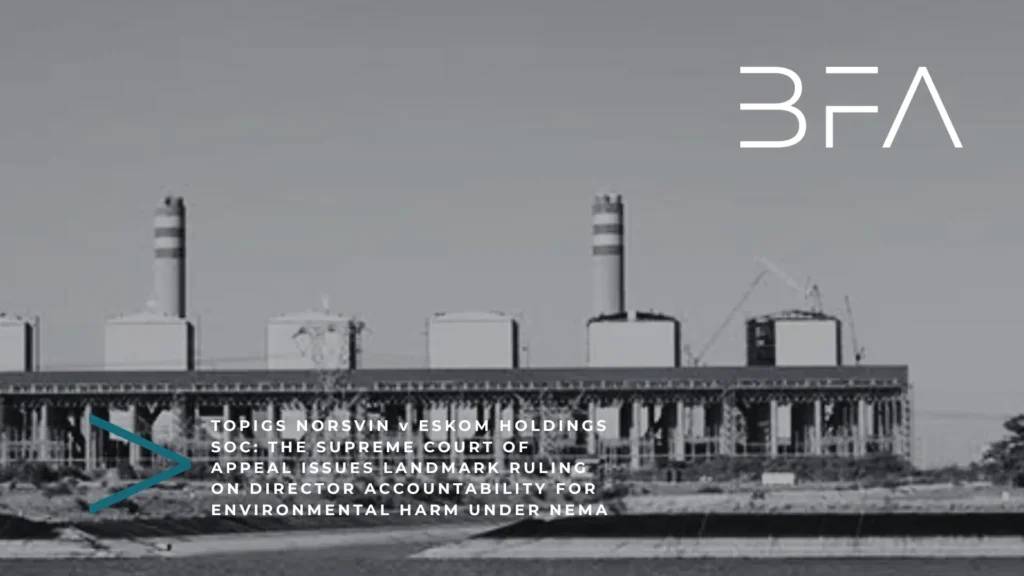
On 14 August 2026, the Supreme Court of Appeal (SCA) handed down judgment in Topigs Norsvin SA (Pty) Ltd v Eskom Holdings SOC Ltd and Others (117/2025) [2026] ZASCA 108, upholding an appeal against a 2024 Pretoria High Court order that had dismissed an application arising from years of water pollution caused by Eskom’s Kusile Power Station in Mpumalanga.
At the outset, the SCA framed the extreme importance of this matter, noting that –
“This appeal highlights the tension between two significant interests: the vital role of industrial activity in national development and economic growth, on the one hand, and the imperative of environmental preservation for the benefit of both present and future generations, as enshrined in South Africa’s Constitution, on the other. The dispute between the parties shines a spotlight on the critical importance of the organs of state’s duty to ensure that coal-fired construction and operation of power plants adhere to the provisions of the environmental authorisations issued in accordance with environmental regulatory standards for the protection of water resources, and the corresponding duty of regulatory bodies to monitor and rigorously enforce compliance with these environmental authorisations as mandated by legislation. This constitutional imperative remains vital, notwithstanding the recognition of industrialisation’s essential role in driving economic growth”.
Following its deliberation, the SCA found Eskom to have fundamentally contravened its various environmental obligations at the Kusile Power Station, declaring that its current board and the relevant state regulators are under a legal duty to ensure that water resources downstream of Kusile comply with the applicable environmental authorisations, waste licence and water use licences, and that Eskom’s persistent failure to prevent and rectify this pollution was unlawful and unconstitutional. The Court ordered Eskom’s current board to file a detailed, sworn action plan within 30 days and a sworn compliance report within 60 days, and directed the Directors-General of the Department of Water and Sanitation (DWS) and the Department of Forestry, Fisheries and the Environment (DFFE) to assess enforcement action against Eskom within 75 days.
Bishop Fraser Attorneys acted as instructing attorneys for Topigs Norsvin throughout this litigation, briefing Adv M M Oosthuizen SC and Adv N Fourie, and securing this landmark appellate victory on Topigs’ behalf.
Background
Topigs Norsvin SA (Pty) Ltd is a swine genetics producer operating a specialised research and production facility on its property adjacent to the Kusile Power Station in Mpumalanga. The facility produces and supplies specific pathogen-free pig breeding material, and is responsible for over 50% of the breeding stock supplied to the South African and broader Southern African Development Community pork markets. Because it primarily deals in genetics rather than general livestock farming, its operations depend on unusually strict biosecurity and water-quality standards. Given the importance of its commercial operations, and the threat of water pollution from the adjacent Kusile Power Station, Topigs was actively involved in the power plant’s operations, appointing Dr James Meyer as its representative on Kusile’s Environmental Monitoring Committee (EMC) from its inception. The EMC was tasked with monitoring Eskom’s compliance with its environmental obligations, which obligations were contained in environmental authorisations, integrated environmental authorisations and a succession of water use licences issued between 2011 and 2022. These licences required, among other things, that –
- all polluted water be recycled until pollutants are captured as waste;
- that no effluent be discharged into any stormwater drain; and
- that the facility ultimately achieve zero liquid effluent discharge.
Over more than a decade, Dr Meyer documented Eskom’s late, deficient or absent monitoring reports, and persistent breaches of the applicable pollution limits, all of which resulted in the consistent and increasing pollution of the Klipfontein Spruit adjacent to the Kusile Power Station. From there, the polluted water flows directly onto Topigs’ property and into the Wilge River, which forms part of the Upper Olifants River system. As consistently highlighted by Topigs, this ongoing pollution, which rendered the water around Kusile acutely toxic and unfit for human consumption, thereafter followed to downstream water users, farming operations and rural communities who rely on this watercourse for irrigation, livestock watering, and in some cases domestic water use.
Despite Topigs’ persistent calls to remedy the situation, and rather than making efforts to mitigate its environmental impacts, Eskom applied for, and in 2022 obtained, a relaxation of its water use licence limits, yet continued to exceed even those relaxed limits. Having exhausted other avenues, Topigs launched High Court proceedings seeking declaratory relief, a mandamus and a structural interdict. The Pretoria High Court dismissed the application in 2024, holding that Topigs had failed to prove the absence of an alternative remedy, and that it should have relied on section 28(12) of the National Environmental Management Act 107 of 1998 (NEMA) rather than approaching the court directly.
The Sca’s Key Findings
- Eskom’s conduct was unlawful and unconstitutional – on the undisputed monitoring data, and Eskom’s own admission that its operations had negatively impacted downstream water resources, the Court found that Eskom had persistently breached section 28 of NEMA and section 19 of the National Water Act 36 of 1998 (NWA), and that this breach was unlawful and infringed the environmental right in section 24 of the Constitution;
- The principle of subsidiarity did not bar the claim – the SCA held that Topigs’ case was substantively grounded in NEMA and the NWA, with the Constitution invoked only in support, and that section 28(12) of NEMA is not an exclusive remedy, as argued by Eskom. The High Court had erred in treating Topigs’ failure to invoke that section by name as fatal;
- A structural interdict was inappropriate, but declaratory and mandamus relief was not – given the technical complexity of ongoing compliance monitoring and Eskom’s subsequent action plans, an open-ended structural interdict with rolling court supervision would improperly draw the judiciary into a technical oversight role. Declaratory orders and a time-bound mandamus, however, were appropriate and did not offend the separation of powers, as argued by Eskom;
- The state regulators had acted unlawfully – the Directors-General of the DWS and DFFE were found to have acted unlawfully in failing, for years, to enforce compliance with the applicable environmental and water use frameworks, and were directed to exercise their statutory powers lawfully and without undue delay, and not to treat enforcement as a matter of unfettered discretion once non-compliance has been established; and
- Eskom’s directors were found to be personally accountable –notwithstanding the general principle of limited liability under the Companies Act 71 of 2008, exposes the directors of a company, or members of a close corporation, to potential joint and several liability for environmental harm caused by the entity they represent, whether that harm is caused intentionally or unintentionally. This landmark ruling is expanded on below.
The Precedent On Director Accountability Under Section 24n(8) Of Nema
A central and closely watched aspect of the judgment concerns the personal accountability of company directors for environmental harm. The SCA confirmed that, under section 24N(8) of NEMA, that directors are the controlling mind of a company, bearing the duty and power to oversee and control it, and that the potential for a costs order against directors on this basis justified their citation as respondents in the litigation.
Critically, the Court drew a sharp distinction between this position and that of ordinary employees, even those in senior management roles: employees acting on instruction and within the scope of their employment do not have the direct and substantial interest required for proper joinder, whereas directors, by virtue of section 24N(8), do. This is an important clarification for how environmental litigation against corporate polluters should be structured going forward, confirming that directors cannot rely on the separate legal personality of the company to avoid being properly joined to proceedings of this kind.
The practical force of this principle is reflected directly in the Court’s order: Eskom’s current sitting board members, cited individually by name as respondents, were ordered personally to file a detailed action plan under oath within 30 days, and a compliance report under oath within 60 days, on pain of the Court’s further supervisory and contempt powers. While Topigs did not persist with relief against Eskom’s former directors, the order against the current board illustrates precisely the kind of personal, individual accountability that section 24N(8) is designed to enable, and signals that South African courts will not hesitate to bind directors personally where environmental non-compliance by their company has been established.
In light of this judgment, the SCA has made clear that –
- Directors cannot hide behind the corporate veil – directors of companies conducting NEMA-regulated activities may be personally and individually joined, and bound, in environmental enforcement litigation under section 24N(8), regardless of whether the harm was caused intentionally;
- Regulators face a positive duty to act – the DWS and DFFE can no longer treat their enforcement powers under NEMA and the NWA as a matter of unfettered discretion once non-compliance has been objectively established;
- Neighbours and affected third parties have real standing – businesses and individuals affected by a polluter’s conduct have court-tested standing to seek declaratory and mandamus relief, even without first invoking section 28(12) of NEMA by name; and
- Seeking relaxed licence conditions is not a substitute for compliance – courts will scrutinise historic under-reporting and delayed monitoring data closely, and a company that seeks to relax its licence conditions rather than remedy non-compliance should expect no protection from liability.
Eskom’s Own Admissions, And The Court’s View Of The Public Interest
Another striking feature of the judgment is that Eskom did not seriously dispute the underlying pollution. The SCA recorded, and returned to more than once, that “Eskom stated that it does not deny that its operations at Kusile have negatively impacted downstream water resources.” Eskom’s own deponent went further, conceding that “the high concentrations of manganese, chromium and fluoride can adversely affect human health“, while seeking to limit the consequences of that concession by denying that harm had been proven to have occurred to any specific person.
- The monitoring data placed before the Court left little room for Eskom’s position to be viewed charitably. Manganese levels recorded in Eskom’s own pollution control dams reached as high as 1 505 mg/L against a permitted limit of 50 mg/L, and exceedances of chromium, aluminium and fluoride persisted, and in places worsened, even after Eskom had itself applied for, and obtained, a relaxation of its water-use licence limits in 2022. The Court observed that Eskom’s pattern of seeking to relax its licence conditions, rather than achieve compliance with them, was a matter it regarded with evident concern, noting elsewhere in the record the description of this practice by Topigs’ expert, Dr Meyer, as an “alarming” and “distinct pattern” of accommodating Eskom’s own failings through further relaxations rather than remediation.
- The Court did not mince its language in describing the consequence of this. It held that “the extent of Eskom’s egregious non-compliance with the EA and water-use licences and the DFFE’s failure to intervene” was self-evident from the record, and endorsed the High Court’s own finding that Topigs’ expert “has been a thorn in the flesh on the EMC about Eskom’s monitoring processes and non-compliance … and the lax attitude of the State respondents in holding Eskom accountable“, adding that “a finding of unlawfulness is inevitable in the circumstances“. The Court went on to describe it as “astonishing” that Eskom had contended Topigs’ application was premature, holding that “the record before us leaves no room for any doubt that Eskom has, over a sustained period, failed to comply with material conditions of its environmental authorisations“, and that this non-compliance “amounts to a breach of statutory duty and renders the conduct of the Eskom respondents unlawful“. More broadly, the Court described the years-long failure of the State respondents to diligently perform their constitutional obligations as “inexcusable.”
The Court was equally forthright in rejecting the respondents’ attempt to characterise the dispute as a private matter between neighbours. Counsel for the respondents had submitted that the issues on appeal carried no public interest element, being confined to “a disagreement between neighbours“. The Court’s response was unequivocal: “I disagree.”
- The judgment holds that public interest in a matter of this kind comprises both the lawful exercise of power by an organ of state such as Eskom, and the protection of natural resources, and that public interest “ought to be defined by the nature of the right, not the number of victims affected by an impermissibly polluted environment“. The Court noted that rivers “flow beyond the boundaries of the properties outlined in the title deeds”, so that pollution left unchecked at one point in a catchment inevitably places downstream communities, including those with far fewer resources than Topigs, at risk. It observed that the burden of contaminated water falls hardest on marginalised communities, such as farmworkers living near polluting plants who lack the financial means to buy safe bottled water or seek specialised medical care, and invoked the Constitutional Court’s description of environmental protection as “a matter of intergenerational justice”.
- The Court further reasoned that allowing an organ of state to ignore the conditions of its own environmental authorisation would “significantly undermine the integrity of the regulatory system”, with a potential “domino effect” and “cumulative impact” reaching other rivers serving far larger communities than the 144 people employed on Topigs’ farm. On this basis, the Court held that the public plainly “has an interest in knowing whether state agencies are adhering to the law and, if not, whether they are being held accountable”, describing this as “an inherently public interest issue regardless of the number of victims.” This reasoning materially broadens the practical scope for affected businesses and individuals to invoke the public interest in environmental enforcement litigation against state-owned entities and other significant polluters.
Bishop Fraser Attorneys’ Role In Securing This Outcome
Bishop Fraser Attorneys, instructing Adv M M Oosthuizen SC and Adv N Fourie, represented Topigs Norsvin throughout this litigation, from the original High Court application through to this successful appeal before the Supreme Court of Appeal.
This judgment represents a significant vindication for Topigs after more than a decade of documented non-compliance by Eskom, built on the sustained, technically grounded evidence gathered by Topigs’ environmental expert, Dr Meyer, through his long-standing participation in the Kusile Environmental Monitoring Committee. Beyond the binding compliance obligations now imposed on Eskom and the responsible state regulators stands as proof that courts will not shy away from ruling against State entities.
How Bishop Fraser Attorneys Can Assist
Bishop Fraser Attorneys advises companies and their directors on NEMA and NWA compliance, personal liability exposure under section 24N(8), litigation strategy for both applicants and respondents in environmental enforcement disputes, and engagement with environmental and water regulators. This judgment underscores the value of proactive compliance review, and of decisive legal action where a business is adversely affected by a neighbour’s non-compliance with its environmental authorisations.