

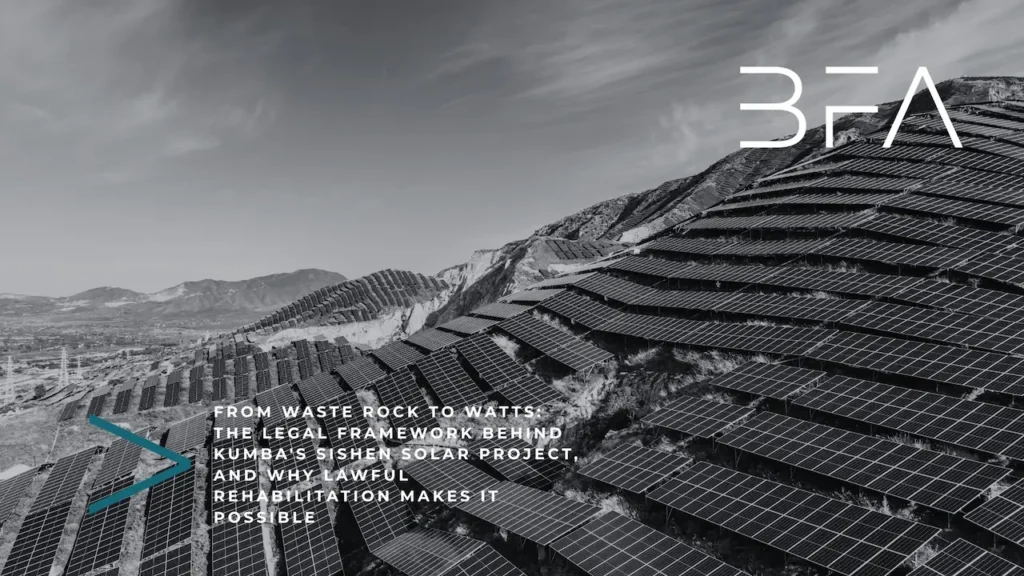
Kumba Iron Ore’s Sishen Iron Ore Company (SIOC) has reached financial close on an embedded solar photovoltaic project to be built on the rehabilitated G80 waste rock dump at its Sishen mine in the Northern Cape. SIOC has entered into an energy offtake agreement with Envusa Energy, a joint venture between Anglo American and EDF Power Solutions, for the on-site supply of electricity generated by the facility.
The plant will have an installed capacity of 72.5 MWp direct current and 63 MW alternating current, occupy approximately 100 hectares atop a rehabilitated waste rock dump described as roughly 20 storeys high, and is expected to generate about 150 GWh of electricity annually, reducing Sishen’s carbon dioxide emissions by approximately 140 000 tonnes a year. It is described by its developer as South Africa’s first embedded solar project built on a rehabilitated mine waste rock dump within an operating mine, with first electrons expected in the fourth quarter of 2027.
Background: From Environmental Liability To Energy Asset
Waste rock dumps are historically treated as a long-term environmental liability requiring rehabilitation and closure under South Africa’s mining and environmental legislation, with mining companies obliged to maintain financial provision for their eventual remediation. Increasing pressure to decarbonise operations, reflected here in Kumba and Anglo American’s 2030 climate targets, has driven a growing trend toward finding productive after-uses for legacy mine land, rather than limiting rehabilitation to vegetation cover and erosion control alone.
The Sishen project also incorporates engineering solutions specific to its site, including fixed-tilt panel structures with adjustable legs and a mobile, adjustable substation, designed to accommodate the continued settlement of the rehabilitated dump over time. This is a material legal, as well as engineering, consideration, since the ongoing stability and monitoring of the dump remains subject to the mine’s approved environmental management programme even after the solar facility is commissioned.
The Legal Framework Governing Repurposed Mine Land
Converting a rehabilitated waste rock dump into a solar generation facility engages several distinct regulatory regimes, each of which must be satisfied before such a project can lawfully proceed –
- Amendment of the mine’s environmental management programme – under the Mineral and Petroleum Resources Development Act 28 of 2002 (MPRDA), a change in the approved post-mining land use of a waste rock dump, from vegetated closure to industrial energy infrastructure, requires formal amendment of the environmental management programme and associated financial provision for the site, since the closure and rehabilitation obligations attaching to the dump do not fall away simply because it now hosts a solar facility;
- A separate environmental authorisation for the solar facility – the construction and operation of a facility of this size constitutes a listed activity in its own right under the National Environmental Management Act 107 of 1998 (NEMA), triggering its own environmental authorisation process, distinct from the authorisation originally granted for the mine itself, although sited on already-disturbed land, which may streamline aspects of the assessment;
- Registration with the energy regulator – under the Electricity Regulation Act 4 of 2006, as amended, embedded generation facilities of this kind must be registered with the National Energy Regulator of South Africa (NERSA). Because the electricity is being supplied directly to the mine under an offtake arrangement rather than sold into the national grid, the project falls to be structured and registered as embedded, rather than grid-tied, generation;
- Coordination between the mineral right holder and the developer – because the solar facility is sited within the boundary of an existing mining right and on land forming part of the approved mining operation, contractual arrangements between SIOC, as mining right holder, and Envusa, as developer and generator, must clearly allocate responsibility for the ongoing rehabilitation and monitoring obligations attaching to the underlying waste rock dump; and
- Alignment with Mining Charter and social and labour plan commitments – the SIOC Community Development Trust’s 10% interest in the project is structured to ensure host communities share in the project’s dividend flows, aligning the transaction with the transformation and community development obligations imposed on mining right holders under the MPRDA and the Mining Charter.
The Regulatory Reforms That Made Embedded Generation Possible
Projects of this kind have only become commercially and legally viable in recent years following amendments to Schedule 2 of the Electricity Regulation Act, which removed the previous licensing threshold that had, for many years, restricted the size of embedded generation facilities a private company could develop without a full NERSA generation licence. In place of that threshold, developers and off-takers are now required to register qualifying embedded generation facilities with NERSA, a materially less onerous process that has been central to unlocking private investment in mine-based and industrial self-generation across South Africa.
This reform is directly reflected in the structure of the Sishen transaction. Kumba distinguishes between the wheeled renewable electricity already being supplied to its Kolomela mine, delivered over the Eskom network from Envusa’s Koruson 2 cluster of utility-scale wind and solar projects in the Eastern and Northern Cape, and the embedded electricity that will be generated and consumed on-site at Sishen. Wheeling arrangements engage a separate set of contractual and regulatory considerations, including use-of-system agreements with Eskom or the relevant municipal distributor, whereas embedded generation of this kind is consumed directly by the mine without using the grid as an intermediary, simplifying the regulatory interface but requiring the generation facility to be sited, as here, within the mine’s own boundary.
Why Lawful Rehabilitation Is The Precondition For Projects Like This
It is worth emphasising that this project was only possible because the underlying waste rock dump had been rehabilitated, monitored and maintained in accordance with South Africa’s mining and environmental legal framework over a sustained period. A dump capable of bearing new infrastructure, engineered for stability, subject to an approved and actively managed environmental management programme, and held under a valid mining right, is fundamentally different from the derelict, informally worked or illegally mined sites that continue to pose serious risks across South Africa.
As we have discussed in previous updates, unlawful and illegal mining operations, frequently conducted at abandoned or unrehabilitated workings, take place entirely outside the licensing framework established by the MPRDA, NEMA, the National Water Act 36 of 1998 and related legislation. Such operations lack any equivalent environmental management programme, structural engineering oversight or financial provision for rehabilitation, and are correspondingly incapable of ever being repurposed for productive after-uses of this kind. They remain, instead, ongoing safety hazards, sources of environmental degradation, and, as recent fatal incidents at disused workings have illustrated, a continuing risk to life. The contrast between a rehabilitated, income-generating former waste dump and an unrehabilitated, unlawfully worked site is a clear illustration of why strict compliance with the full chain of mining, environmental and water licensing obligations, not only at the exploration and production stage, but through to closure, remains essential.
Potential Impacts On The Mining And Energy Sector
The Sishen project is likely to be closely watched by other mining companies and renewable energy developers, and carries the following implications –
- A template for repurposing legacy mine residue – other mining right holders with rehabilitated waste dumps or tailings storage facilities may look to replicate this model, but must first ensure that their environmental management programmes and financial provision are formally updated to reflect the new post-mining land use before construction begins;
- Increased regulatory coordination – projects of this kind require close coordination between the mineral resources regulator responsible for mine closure and rehabilitation compliance and the energy regulator responsible for embedded generation registration, creating a regulatory interface that is still relatively novel in South Africa;
- Decarbonisation and transformation value – embedding renewable generation into legacy mine infrastructure allows mining companies to advance both their decarbonisation commitments and their Mining Charter transformation obligations simultaneously, through structures such as community trust equity participation, and may become a standard feature of forward-looking mine closure planning;
- Revised closure liability calculations – where a rehabilitated site now hosts revenue-generating infrastructure with its own decommissioning obligations, financial provision calculations for the site’s ultimate closure will need to account for both the original mining rehabilitation liability and the solar facility’s eventual decommissioning; and
- A reinforced compliance premium – the project underscores that only mining operations conducted, rehabilitated and closed in full compliance with the applicable licensing framework are capable of unlocking this kind of productive second life for mine residue, reinforcing the wider regulatory and reputational premium on lawful, properly licensed mining.
How Bishop Fraser Attorneys Can Assist
The Sishen Solar PV project illustrates the growing legal and commercial opportunity in repurposing rehabilitated mine land for renewable energy generation, alongside the regulatory complexity such projects involve.
Bishop Fraser Attorneys advises clients on MPRDA environmental management programme and closure plan amendments, NEMA environmental authorisations for renewable energy facilities on mine land, NERSA registration and offtake or wheeling agreement structuring, and the design of community trust and transformation structures aligned with Mining Charter requirements. Early legal structuring of these projects can help mining companies unlock long-term value from rehabilitated land while remaining fully compliant with their ongoing closure and rehabilitation obligations.