

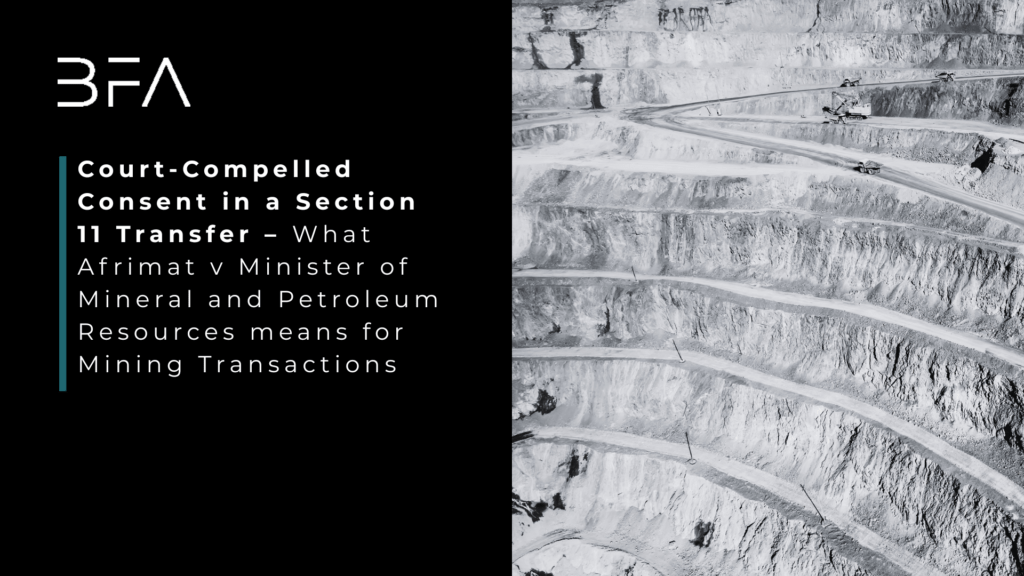
On 18 May 2026, the High Court (Gauteng Division, Pretoria) handed down judgment in Afrimat Limited v Minister of Mineral and Petroleum Resources and Others [2026] ZAGPPHC 403, in which the Court reviewed and set aside the failure of the Director‑General of the Department of Mineral and Petroleum Resources (DMPR) to take a decision on a section 11 transfer application under the Mineral and Petroleum Resources Development Act 28 of 2002 (MPRDA), and ordered that ministerial consent be granted within four days.
Of particular importance for mining transaction practice, the Court did not remit the matter to the Director‑General for a fresh decision. Instead, it stepped into the shoes of the decision‑maker and effectively granted the consent itself. The Court also rejected an intervention by a third party who claimed to hold an “interest” in the mining right by virtue of being the spouse of a deceased shareholder in the corporate holder of the right.
Background
Section 11(1) of the MPRDA prohibits the transfer of a prospecting right, mining right, or any controlling interest in such a right without the written consent of the Minister. Section 11(2) prescribes a 60‑day decision window once a complete application has been lodged, although in practice the timeline is materially longer.
The dispute in Afrimat arose from Afrimat’s acquisition of the Ochre Shimmer mining right, a right granted under the MPRDA in respect of iron ore reserves at Doornfontein in the Northern Cape. Afrimat acquired the right on 30 May 2025 and applied for section 11 consent on 30 June 2025.
By the date of the hearing, nine months had elapsed without a decision. In the interim, Afrimat had become subject to a hard commercial deadline: it needed a certified copy of a valid and current mining right issued by the DMPR to lodge its application for a 10‑year capacity allocation on Transnet’s Iron Ore Export Corridor (IOEC) by 29 May 2026. Without that allocation, the Doornfontein operation could not realistically be brought to market at scale, and the closure of Afrimat’s Demaneng mine (anticipated late 2026 or early 2027) could not be backfilled by the new asset.
The Minister, the Director‑General and the regional manager initially opposed the application but ultimately withdrew their opposition. The matter was opposed at the hearing only by Ms Lungile Mlotshwa, the wife in community of property of the late Mr BN Mhlangu, who had been a shareholder in Ochre Shimmer prior to his death.
The Court’s Approach
Who Holds An “Interest” In A Mining Right For Section 11 Purposes?
The intervening party argued that, as the spouse in community of property of a deceased shareholder of the corporate holder, she had an “interest” in the underlying mining right that required to be considered before consent to the transfer could be granted.
The Court rejected that proposition. The mining right is held by Ochre Shimmer, a separate juristic person, and not by the individuals behind it. The interest of any shareholder (or, derivatively, a shareholder’s estate or spouse in community of property) is an interest in the company and not an interest in the mining right itself.
That distinction is decisive for section 11 purposes: it is the right (or an interest in the right) that triggers the consent requirement, not every downstream economic interest of a natural person standing behind the corporate holder.
This is a useful crystallisation of a question that section 11 transactions routinely surface, particularly in family‑held mining companies, deceased estates, and divorce proceedings, where the line between “interest in the company” and “interest in the right” is often blurred by parties seeking to assert a right of veto over a corporate sale.
The Director‑General’s Delay And The PAJA Review
The Court treated the Director‑General’s failure to take the consent decision as administrative action capable of review under the Promotion of Administrative Justice Act 3 of 2000 (PAJA), specifically as a failure to take a decision in accordance with the MPRDA. Nine months without a decision, on the facts before the Court, was not a defensible exercise (or non‑exercise) of the section 11 power.
The Court was satisfied that the only reason the consent had not been issued was a “misunderstanding” on the part of the Director‑General.
Why The Court Substituted Its Own Decision
The more significant procedural development in the matter was the remedy actioned by the Court. The default position on PAJA review under section 8(1)(c)(ii) is that a court will set aside the impugned (in)action and remit the matter to the decision‑maker.
Substitution, insofar as the Court takes the decision itself, is exceptional and is generally reserved for cases where remittal would be futile, where the outcome is a foregone conclusion, where the decision‑maker has shown bias or incompetence, or where delay would cause manifest injustice. The Court found that this matter was such a case. The Court took into account, in addition to Afrimat’s clear commercial interest:
- The time‑critical nature of the IOEC bid window, which closed on 29 May 2026
- The significant capital already invested in the asset
- The dependency of approximately 175 permanent staff, 930 contractors, and (factoring in the rollover of Demaneng employees) some 1 100 families on the operation
- The prospective creation of an additional 150 contractor and service‑provider positions at Doornfontein
- The fact that any further delay would leave Afrimat without an effective remedy
On that basis, the Court held that it was just and equitable under PAJA to substitute its own decision and to compel the grant of consent, with written confirmation to follow by no later than 20 May 2026. Costs were awarded against the Director‑General.
Implications For Section 11 Practice
The judgment develops the understanding of section 11 in three practical respects.
- First, on the scope of consent. The Court has reinforced that, absent a transaction that itself disposes of the mining right or a controlling interest in the corporate holder, downstream personal interests in shareholders of a corporate holder are not “interests in the right” for section 11(1) purposes. Practitioners advising on family‑held mining companies, deceased estates that include shares in such companies, and the matrimonial‑property consequences of marriages in community of property can take comfort that the consent requirement does not silently expand to capture every economic stakeholder.
- Second, on administrative delay. The Director‑General’s section 11 function is administrative action. Inertia is reviewable, and the section 11 timeline of 60 days carries weight. Where a transaction is time‑sensitive and the application is complete, applicants should not assume that delay is simply a fact of regulatory life.
- Third, and most strikingly, on remedy. Substitution under PAJA in the section 11 context has historically been rare. Afrimat signals that, where the merits are uncontested, the decision‑maker’s delay is unexplained or attributable to a “misunderstanding”, and the applicant faces irreversible commercial or employment‑related harm, the High Court is prepared to grant the consent itself rather than remit. That is a meaningful shift in the practical leverage available to applicants caught in the section 11 queue.
How Bishop Fraser Attorneys Can Assist
Section 11 transfers are a core part of Bishop Fraser Attorneys’ mining law practice. We advise mining companies, acquirers, financiers and shareholders on:
- Structuring transactions to manage section 11 (and section 102) consent triggers
- Preparing and submitting section 11 applications, including the negotiation of supporting documentation and BEE compliance positions
- Managing the regulatory timeline against commercial deadlines, including rail and port allocations, financing conditions and expiry windows
- Responding to and managing third‑party interventions in section 11 processes
- PAJA review of administrative delay or refusal in the section 11 process, including, where appropriate, applications for substitution as endorsed in Afrimat
The Afrimat judgment is a welcome development for applicants caught in the section 11 queue and a useful refinement of the law on who must consent to a transfer. Early engagement on the regulatory pathway, at deal structuring rather than at deadline, remains the most effective protection against the kind of delay that Afrimat was forced to litigate.