

Overview
With effect from 1 July 2026, the Minister of Justice and Constitutional Development, Ms MT Kubayi, MP, has, under Government Notice 7648, published in Government Gazette No. 54935 of 2 July 2026 (signed at Pretoria on 27 June 2026), determined new areas of jurisdiction for the main and local seats of the Divisions of the High Court of South Africa. The Notice was issued under section 6(3)(a) and (c) of the Superior Courts Act 10 of 2013 (the Act), read with Item 16(6)(a) and (b) of Schedule 6 to the Constitution, and after consultation with the Judicial Service Commission.
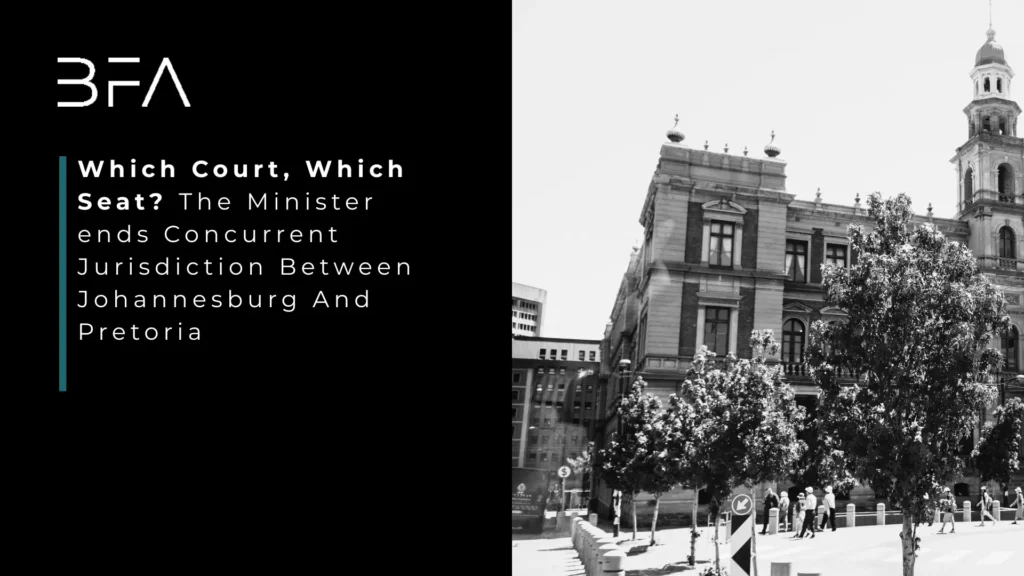
For practitioners in Gauteng, the most significant practical consequence is that the Johannesburg and Pretoria seats of the Gauteng Division no longer share concurrent jurisdiction over any part of the province. Each seat now has a defined, mutually exclusive geographic area, and a matter must be instituted in the seat assigned to the area in which it arises.
Background
The Statutory Framework
Section 6 of the Act empowers the Minister, after consultation with the Judicial Service Commission, to determine by notice in the Gazette the area under the jurisdiction of the main seat of a Division and of any local seat within that Division. This power gives content to the architecture established when the current nine Divisions of the High Court, each anchored to a main seat with one or more local seats, replaced the pre-2013 array of provincial and local divisions. Item 16(6) of Schedule 6 to the Constitution preserves the jurisdiction that existed immediately before the Act commenced, until the Minister exercises this power to alter it.
Concurrent Jurisdiction In Gauteng Under The 2018 Determination
When the former North Gauteng and South Gauteng High Courts were consolidated into a single Gauteng Division, with Pretoria as the main seat and Johannesburg as a local seat, GN 408 of 2018 set out the areas assigned to each. This gave the Johannesburg High Court concurrent jurisdiction until its own area of jurisdiction was determined.
The New Determination
Under the Schedule, the Minister has fixed, Division by Division, the areas under the jurisdiction of each main seat and each local. For the Gauteng Division –
- Pretoria, as the main seat, has jurisdiction over the entire Tshwane Magisterial District, including the Atteridgeville, Bronkhorstspruit, Cullinan, Ekangala, Mamelodi, Moretele (Temba), Ga-Rankuwa (Odi), Pretoria North and Soshanguve Sub-Districts (excluding Brits).
- Johannesburg, as a local seat, has jurisdiction over the entire Ekurhuleni, Johannesburg, Sedibeng and West Rand Magisterial Districts — including, among other areas, Benoni, Boksburg, Germiston, Kempton Park, Springs and Tembisa (Ekurhuleni); Alexandra, Booysens, Lenasia, Randburg, Roodepoort and Soweto (Johannesburg); Vereeniging, Heidelberg, Meyerton and Vanderbijlpark (Sedibeng); and Krugersdorp, Fochville, Randfontein and Westonaria (West Rand).
Because each area of the province now appears in the Schedule against only one seat, there is no longer any area of Gauteng in respect of which a litigant may elect between Pretoria and Johannesburg. The seat in which proceedings must be instituted is determined by the magisterial district in which the relevant jurisdictional fact (for example, where the cause of action arose, where the defendant resides, or where the property in question is situated) is located, read against the Schedule.
The Notice makes equivalent, exhaustive determinations for the remaining eight Divisions, including the Limpopo, Mpumalanga and North West Divisions affected by the withdrawn 2015, 2018 and 2019 notices, and the Eastern Cape, Free State, KwaZulu-Natal, Northern Cape and Western Cape Divisions.
Practical Significance
Practitioners and litigants active in Gauteng, and more broadly across the affected Divisions, should note the following.
- Venue can no longer be a matter of choice. Where a cause of action arises in an area that previously fell within the concurrent jurisdiction of Johannesburg and Pretoria, only one seat now has jurisdiction. The Schedule, not prior practice, is determinative and should be consulted before any process is issued.
- Boundary areas require particular care. Sub-districts sitting at the edge of a magisterial district (for example, areas bordering Ekurhuleni and Tshwane) should be checked precisely against Column D of the Schedule, rather than assumed by reference to prior practice.
- Wrong-seat proceedings carry cost and delay risk. Instituting proceedings in a seat that no longer has jurisdiction over the relevant area may expose a litigant to a jurisdictional challenge, transfer, or the striking of the matter from the roll, with adverse cost consequences.
- The change is not confined to Gauteng. The withdrawal of the 2015, 2018 and 2019 notices means the Limpopo, Mpumalanga and North West Divisions are also affected, and their areas of jurisdiction should likewise be re-checked against the new Schedule.
- Local Division practice directives will likely follow. Judge Presidents typically issue practice directives to give effect to changes of this kind. Practitioners should watch for updated directives from the Gauteng Division confirming how the new boundaries will be applied administratively, including in relation to the allocation of urgent applications.
How Bishop Fraser Attorneys Can Assist
Bishop Fraser Attorneys advises clients on questions of forum, jurisdiction and venue as a routine part of litigation strategy. In light of the new determination, we can assist with:
- auditing current and pending litigation in Gauteng, and in the other affected Divisions, against the new Schedule, to confirm that each matter is, or remains, before a seat with jurisdiction;
- advising on the correct seat in which to institute new proceedings, including in boundary areas or areas that previously fell within concurrent jurisdiction;
- responding to, or raising, jurisdictional challenges arising from the transition, including the scope and application of the transitional provision in paragraph 2 of the Notice;
- reviewing jurisdiction and venue clauses in commercial contracts and standard terms that reference the Johannesburg or Pretoria seats of the Gauteng Division, to ensure they remain accurate; and
- monitoring further practice directives issued by the affected Divisions to give effect to the new determination.
The immediate risk created by this determination is procedural rather than substantive: a matter that is sound on the merits can still fail, or be delayed, if instituted in a seat that has lost jurisdiction over the relevant area. Practitioners who have relied on the informal flexibility permitted under the 2018 determination should treat the new Schedule as an immediate item for review, rather than a housekeeping matter to be addressed at the next round of process.