

Overview
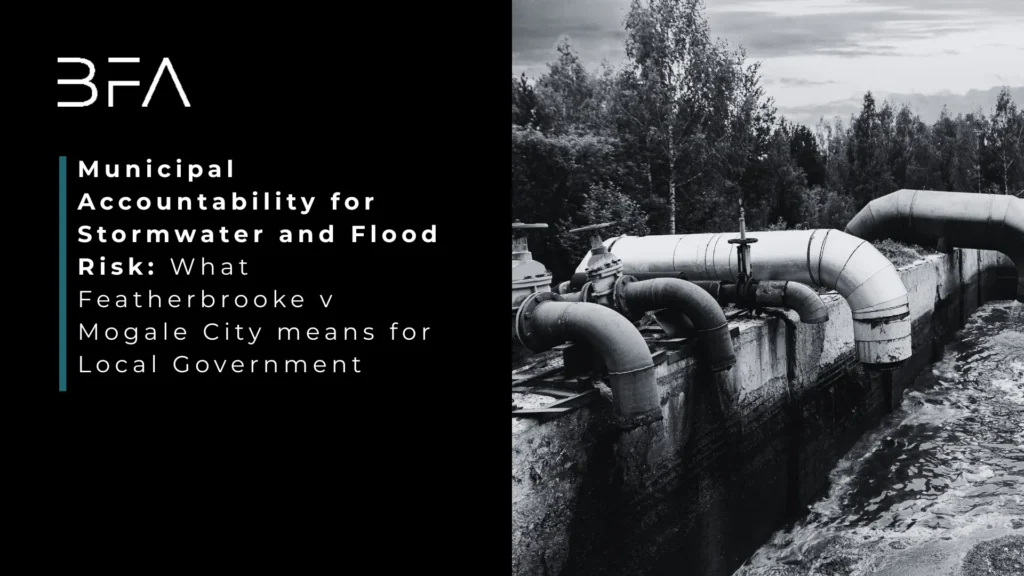
On 29 May 2026, the High Court (Gauteng Local Division, Johannesburg) handed down judgment on remittal in Featherbrooke Homeowners Association NPC v Mogale City Local Municipality and Others (Case No. 11292/2020), in which the Court granted a final mandatory interdict compelling Mogale City Local Municipality (Mogale City), the City of Johannesburg Local Municipality (COJ), the Johannesburg Roads Agency (JRA) and the Minister of Water Affairs and Sanitation (Minister) to undertake the structural and remedial works necessary to address chronic flooding of the Featherbrooke Estate by the Muldersdrift Se Loop river.
The judgment is the second pass at the matter by the High Court, following a remittal by the Supreme Court of Appeal in Featherbrooke Homeowners’ Association NPC v Mogale City Local Municipality (1106/2022), which had set aside the previous High Court order on the basis that the Court had failed to determine the legal issues against each of the cited State entities. On remittal, the Court did exactly that: it identified, for each respondent, the constitutional and statutory source of the duty, found that the duty had been breached, and tailored a remedy to the breach.
Background
The Featherbrooke Estate was declared an approved township in February 1996. Its boundary security fence runs along the Muldersdrift Se Loop, a natural watercourse that originates in the Manie Mulder Gorge within Mogale City, forms the boundary between Mogale City and COJ, and eventually discharges into the Hartbeespoort Dam. The river is owned by the National Government as public trustee under the National Water Act 36 of 1998 (NWA).
Since 2010, the Estate has experienced increasingly severe flooding. The flooding has progressively exposed sewer and electrical power infrastructure, undermined the boundary security fence, and (on the unchallenged evidence before the court) created a real and imminent risk of electrocution, sewage contamination and security failure. Featherbrooke had spent some R5 million on remedial works of its own and, after more than a decade of correspondence with the municipalities and the Department of Water and Sanitation, approached the Court for a mandatory interdict.
The matter was first heard by the High Court, which granted limited relief against Mogale City alone. The SCA set that order aside, finding that Featherbrooke had “carefully cast its net wide” to include each of the relevant State entities in the alternative, and that the High Court was obliged to resolve the obligations and relief sought against each. The SCA also rejected the Full Court’s reasoning that Featherbrooke’s only remedy was to apply for a water use licence. The matter was remitted to determine, in respect of each respondent, whether it owed a duty and, if so, what relief was appropriate.
The Court’s Approach
Mogale City: clear constitutional and statutory duty
Mogale City raised a familiar suite of defences to Featherbrooke’s proceedings, inlcuding –
- regulation of the flow of water in a river falls outside its competence;
- stormwater management is limited to “built-up areas”;
- the developer of the Estate bore the original stormwater obligation;
- parts of the Estate were constructed within the flood line;
- the NWA places responsibility on the Minister, while section 19(1) of the NWA places an obligation on Featherbrooke itself to take preventive steps; and
- in any event, the Municipality could not be ordered to repair infrastructure for which it had not budgeted.
The Court dismissed each of these in turn. The Court located Mogale City’s duty in sections 152 and 156 of the Constitution, read with Part B of Schedule 4 (“stormwater management systems in built-up areas”) and Part B of Schedule 5 (“municipal planning”, “control of public nuisances”, “municipal roads”), which together place the management of stormwater within the exclusive domain of local government. The Court relied on the findings of Featherbrooke’s engineering experts that Mogale City was in breach of its own precinct plan and had no operative stormwater management plan for the area as a whole. That was a clear breach of constitutional and statutory duty.
Crucially, the Court treated the budgetary defence as no defence at all. A municipality cannot, by failing to budget for the discharge of an existing constitutional duty, immunise itself against an order requiring it to discharge the duty. The Court also rejected the attempt to shift the obligation back to Featherbrooke under section 19(1) of the NWA, as that section addresses the prevention of pollution by a landowner, and does not displace the municipal stormwater obligation under the Constitution.
COJ and JRA: jurisdictional boundaries are not a shield
COJ and JRA, in a joint answering affidavit, raised a misjoinder defence. They argued that, because the Estate is situated within Mogale City’s jurisdiction, pays rates to Mogale City and receives municipal services from it, COJ owed Featherbrooke no duty.
The Court found that argument to be “fundamentally flawed”. The river traverses both municipal jurisdictions, and stormwater originating in COJ’s area flows into the river and contributes to the flooding. COJ’s own Disaster Management Strategic Action Plan (2016–2020) identifies stormwater as a hazard, recognises that climate change increases the likelihood of weather-related natural disasters, and acknowledges a legislated duty to co-operate with national and provincial spheres and to engage in inter-municipal co-operation with surrounding municipalities, including mutual assistance agreements.
The Court applied the principle of cooperative government enshrined in section 41 of the Constitution, insofar as organs of state must coordinate their actions and assist and support one another. The Court accordingly confirmed that the protection against the potential risk of environmental disaster falls within the section 24 environmental right, and that the fact that Featherbrooke is not within COJ’s direct ratepayer base does not absolve COJ of its duty to prevent pollution and environmental degradation affecting residents of neighbouring municipalities.
The Minister: subsidiarity does not defeat the National Water Act
The Minister raised three principal defences: absence of a legal duty, the principle of constitutional subsidiarity, and material disputes of fact. The subsidiarity argument, that Featherbrooke could not place direct reliance on section 24 of the Constitution because the right is given effect through the National Environmental Management Act 107 of 1998 (NEMA), was rejected. Featherbrooke’s case was not based solely on section 24, and drew on the Disaster Management Act 57 of 2002 (DMA), the NWA and the Local Government: Municipal Systems Act 32 of 2000, and engaged the Minister’s own powers under sections 19, 20, 21, 22 and 67 of the NWA.
The Court located the Minister’s duty in her position as public trustee of the nation’s water resources under section 3 of the NWA, and held that the river is owned by the National Government. As such, the NWA expressly contemplates the management of floods and droughts as part of the purpose of the Act. The Minister therefore owed a legal duty to act, and Featherbrooke was entitled to relief compelling her to do so.
The remedy: a structural mandatory interdict against State entities
The Court applied the trite requirements for a final interdict, which confirms that, once the three requirements are met, there is no general discretion to refuse relief.
On that test, the Court granted a final mandatory interdict in five operative parts:
- Mogale City, COJ and the JRA, jointly and severally, to repair, underpin, remediate and manage the stream beds adjacent to the Estate’s security fencing, including the installation of gabions and the moderation of flow through attenuation dams and culverts;
- Mogale City and COJ, jointly and severally, to draft, approve and implement a Stormwater Management Plan for the area;
- the Minister to mitigate, remediate and prevent flooding of the Estate, including measures upstream from the Walter Sisulu Botanical Gardens;
- Mogale City, COJ and the JRA to repair, remediate and manage exposed State-owned sewer and power infrastructure; and
- costs against Mogale City, COJ, the Minister and the JRA, jointly and severally, on scale C and including the costs of two counsel.
The Court declined to grant the further self-help relief that Featherbrooke had sought (authority to undertake the works itself and recover the cost from the respondents), preferring not to import such a mechanism in the absence of a structured cost-recovery framework in the notice of motion. The structural interdict otherwise stands.
IMPLICATIONS FOR MUNICIPAL ACCOUNTABILITY
The judgment develops the law on municipal accountability for environmental and disaster-risk service delivery in four practical respects.
- First, on the constitutional source of the duty. The duty to manage stormwater is not a discretionary aspect of municipal service delivery. It is anchored in sections 152 and 156 of the Constitution. Where a municipality has no operative stormwater management plan, or is in breach of its own precinct planning, the breach is constitutional in character, and a mandatory interdict is available to enforce it.
- Second, on the budgetary defence. A municipality cannot avoid a court order by pointing to the absence of a budget for the work the order requires. Budgeting is, on the Court’s reasoning, downstream of the constitutional duty, not a precondition for it. This is consistent with the established line of authority on reasonableness review of socio-economic rights but, in the environmental and disaster-risk context, it is a notable rejection of fiscal incapacity as a defence to mandamus.
- Third, on cross-boundary obligations. Municipal boundaries do not insulate a municipality from liability for environmental harm originating within its jurisdiction but felt across the boundary. The principle of cooperative government in section 41 of the Constitution, together with the cross-boundary nature of watercourses, ecosystems and disaster risk, supports an outward-facing duty.
- Fourth, on the DMA as a positive duty. The DMA is not merely a response regime. It imposes a forward-looking duty on all spheres of government to take preventive and mitigating action where conditions of vulnerability exist. Featherbrooke clarifies that an applicant need not wait for harm to crystallise: present conditions of vulnerability are themselves the trigger for the duty. This is potentially significant for communities, operators and landowners whose risk profile reflects identifiable but as-yet-unrealised hazards.
Taken together, these four propositions narrow the range of defences available to a municipality faced with a credible claim of environmental or disaster-risk failure. Subsidiarity, jurisdictional boundary, budget and the “wrong department” defence are each less effective than they have appeared to be, and the structural mandatory interdict is a more readily available remedy than the previous case law suggested.
How Bishop Fraser Attorneys Can Assist
Municipal accountability for stormwater, flood risk, disaster preparedness and environmental harm is a frequent point of friction between mining, industrial and property clients and the local government on whose service delivery they depend. Bishop Fraser Attorneys advises clients on:
- mandamus and structural interdict applications against municipalities and other organs of state for failure to discharge constitutional and statutory environmental, stormwater and infrastructure duties;
- NEMA and NWA compliance, including the interaction between section 24 of the Constitution, the National Water Act and the National Environmental Management Act;
- cross-boundary environmental and disaster-risk obligations, including the application of the cooperative government principle under section 41 of the Constitution; and
- engagement with intergovernmental dispute resolution processes under section 41(3) of the Constitution and the Intergovernmental Relations Framework Act 13 of 2005, as a precursor to litigation.